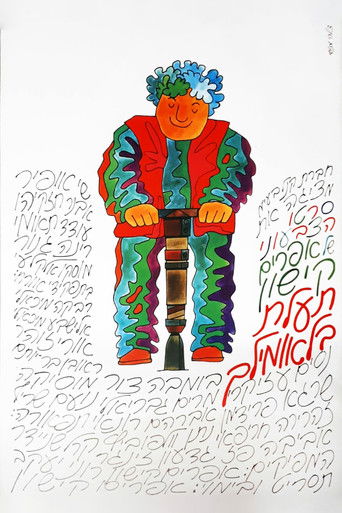
תעלת בלאומילך (1969)
A slapstick comedy lampooning bureaucracy and the madness of everyday life in Israel centers on an escaped lunatic who digs up the streets of Tel-Aviv with a drill.
- 개봉일
- 1969-01-01
- TMDB
- 7.0 / 10 (14)
- 상영 시간(분)
- 1시간 35분
- 장르
- 코미디
- 감독
- Ephraim Kishon
출연진
- Bomba Tzur — Blaumilch
- Nissim Azikri — Yehezkel Ziegler
- Shraga Friedman — Dr. Avigdor Kooiybishevsky
- Avner Hizkiyahu — Menahem Ze'ev Zuckerman
- שייקה אופיר — Police Officer
- עודד תאומי — Dentist
- Albert Cohen — Dr. Gilad
- גדעון זינגר — Police Chief Akiva Levkowicz
- אורי זוהר — Orchestra Conductor
- Ephraim Kishon — Driver
흥미로운 사실
Blaumilch Canal is a 1969 Israeli satirical film written and directed by Ephraim Kishon, depicting the madness of bureaucracy through a municipality's reaction to the actions of a lunatic. The film is based on a humorous story titled "A Legend About a Canal in Tel Aviv" by Kishon, first published in 1952 and later included in the book A Thousand and One Kids.
Production
In February 1952, Ephraim Kishon's comedic short story "A Legend About a Canal in Tel Aviv" was published in the Mapai-affiliated newspaper Davar. The story centers around a mentally deranged former construction worker from Bat Yam named Naftali Berman who escapes from a mental hospital and begins drilling a hole in the middle of Tel Aviv. This short story formed the general basis for Blaumich Canal.
Kishon wanted the film to have an accurate recreation of Allenby Street and its nearby roundabout, and furthermore, that it would have an attempt at recreating the canals of Venice. However, he did not know exactly how feasible this could be, and thus he asked his co-producer, Roni Ya'ackov, to help with this part of pre-production.
The film's cast was also quite extravagant for the time, with many of Israel's then leading actors cast and hundreds of extras recruited. In October 1968, a man named Yigal Himmelblau was indicted on allegations that he scammed some of the extras out of their payments by pocketing some of their pay for himself.
Due to the elaborate set design, any scenes of the film involving the canal had to be filmed last. The filming of the film lasted throughout much of 1968, finishing in November of that year.
Although the film was filmed in colour, no film laboratory existed in Israel at that time that supported colour film, and thus the film's post-production was conducted in England.
위키백과에서 더 읽기 · 텍스트 출처: 위키백과, CC BY-SA 4.0. 데이터 출처: Wikidata.
추천
- 짐 제프리스 - 프리+덤 2016 · ★ 7.2
- 루이 C.K.: 터무니없는 2026 · ★ 6.1
- 데이브 샤펠: 꿈꾸는 사람들 2023 · ★ 6.9
- 퍼킷 리스트 2020 · ★ 6.0
- 데이브 샤펠: 멈출 수 없는 2025 · ★ 6.6
- Chris D'Elia: Man on Fire 2017 · ★ 6.2
- 미 타임 2022 · ★ 5.8
- 폭소 대소동 1977 · ★ 6.6
- Brain Donors 1992 · ★ 6.1
- 2분의 명성 2020 · ★ 6.6
- 리키 저베이스: 죽어도 좋아 2025 · ★ 7.0
- Aziz Ansari: Intimate Moments for a Sensual Evening 2010 · ★ 6.8