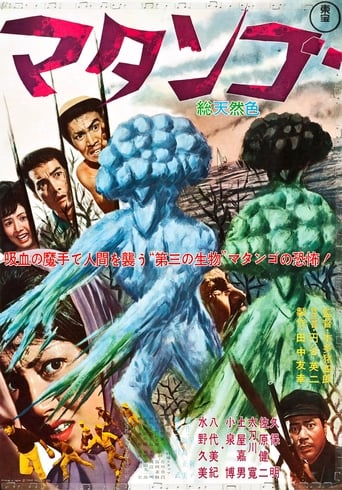
Matango (1963)
マタンゴ
Eine Gruppe betuchter Japaner machen einen Segeltrip. Dabei geraten sie in ein Gewitter und erleiden Schiffbruch. Sie können sich auf eine einsame Insel retten, auf der sie ein altes Forschungsschiff entdecken, das mit Pilzen überwuchert ist.
- Erscheinungsdatum
- 1963-08-11
- TMDB
- 6.7 / 10 (108)
- Laufzeit
- 1 Std. 29 Min.
- Genres
- Horror, Science Fiction, Thriller, Drama, Mystery, Fantasy
- Regie
- Ishirō Honda
Besetzung
- 久保明 — Kenji Murai - Professor
- 水野久美 — Mami Sekiguchi - Singer
- Hiroshi Koizumi — Naoyuki Sakuta - Skipper
- Kenji Sahara — Senzô Koyama - Sailor
- Hiroshi Tachikawa — Etsurô Yoshida - Writer
- Yoshio Tsuchiya — Masafumi Kasai - Owner
- Miki Yashiro — Akiko Sôma - Student
- 天本英世 — Transitional Matango
- 熊谷卓三 — Doctor (as Jiro Kumagai)
- 草間璋夫 — Police Personnel
- 岡豊 — Doctor
- 山田圭介 — Doctor
Wissenswertes
Matango (マタンゴ) is a 1963 Japanese horror film directed by Ishirō Honda. The film stars Akira Kubo, Kumi Mizuno and Kenji Sahara. Partially based on William Hope Hodgson's short story "The Voice in the Night", it centers on a group of castaways on an island who are unwittingly altered by a local species of mutagenic mushrooms.
Production
The film was based on a story in S-F Magazine which Masami Fukushima was an editor of. A treatment was written on the film by Shinichi Hoshi and Fukushima which was then made into a screenplay by Takeshi Kimura. The story itself was based on William Hope Hodgson's short story "The Voice in the Night", which originally appeared in the November 1907 issue of Blue Book.
The script was relatively faithful to Hodgson's story, but added a number of extra characters. Honda was also inspired by a news story about a group of rich kids who took their father's yacht far into the sea and had to be rescued. Early drafts featured characters paralleling their real-life counterparts, as well as reports of ships and aircraft vanishing in the Bermuda Triangle.
Director Ishirō Honda was better known for his kaiju (giant monster) films, but occasionally developed horror films such as The H-Man (1958) and The Human Vapor (1960), where characters become bizarre transformed beings. Honda's last film in this style was Matango. Critic Bill Cooke noted in Video Watchdog that Matango defies easy categorization as a film belonging to either the kaiju (monster) or kaidan (ghost) genres of the era.
In their book Ishiro Honda: A Life in Film, from Godzilla to Kurosawa, Steve Ryfle and Ed Godziszewski stated that both thematically and visually, Matango was "uniquely dark" among Honda's films and was a radical departure from his brightly lit and lighthearted films Mothra and King Kong vs. Godzilla. Art director Shiegkazu Ikuno designed the stark look of the film. Ikuno was the apprentice of the production designer of Godzilla, Satoru Cuko.
According to Yoshio Tsuchiya, Honda took the project seriously, telling actors before production that the film was "a serious drama picture, so please keep this in mind and work accordingly". Tsuchiya also explained that in addition to the official ending of the film, a different ending was shot where Kubo's face was normal.
Auf Wikipedia weiterlesen · Text aus Wikipedia, CC BY-SA 4.0. Daten aus Wikidata.
Empfohlen
- Cold Skin - Insel der Kreaturen 2017 · ★ 6.4
- Insel der verlorenen Seelen 1932 · ★ 6.9
- Don't Be Afraid of the Dark 2010 · ★ 5.8
- Monster Island 2025 · ★ 6.2
- The Last House 2026 · ★ 6.8
- Apostle 2018 · ★ 6.2
- Der Leuchtturm 2019 · ★ 7.5
- The Silence 2019 · ★ 6.0
- Event Horizon - Am Rande des Universums 1997 · ★ 6.6
- The Girl with All the Gifts 2016 · ★ 6.6
- Die Dämonischen 1956 · ★ 7.5
- Splinter 2008 · ★ 6.2