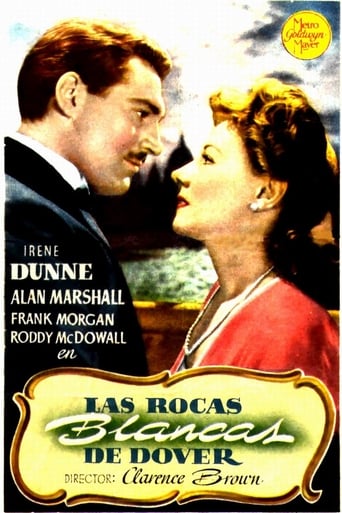
Las rocas blancas de Dover (1944)
The White Cliffs of Dover
Primera Guerra Mundial (1914-1918). Susan y John se casan muy enamorados, pero, al estallar la guerra, él tiene que ir al frente. Después de su muerte en combate, Susan se queda en Inglaterra criando a su hijo. El muchacho, al igual que su padre, se hace militar y cuando estalla la II Guerra Mundial (1939-1945) también participará en la contienda.
- Fecha de estreno
- 1944-05-11
- TMDB
- 6.7 / 10 (23)
- Duración
- 2 h 6 min
- Géneros
- Drama, Bélica, Romance
- Director
- Clarence Brown
Reparto
- Irene Dunne — Susan Dunn
- Alan Marshal — John Ashwood
- Roddy McDowall — John Ashwood II as a Boy
- Frank Morgan — Hiram Porter Dunn
- Van Johnson — Sam Bennett
- C. Aubrey Smith — Walter Forsythe
- May Whitty — Nanny
- Gladys Cooper — Jean Ashwood
- Peter Lawford — John Ashwood II as a Young Man
- John Warburton — Reggie Ashwood
- Jill Esmond — Rosamund
- Brenda Forbes — Gwennie
Curiosidades
- Premios: 0 · Nominaciones: 1
The White Cliffs of Dover is a 1944 American war drama film based on the verse novel The White Cliffs by Alice Duer Miller. It was made by Metro-Goldwyn-Mayer, directed by Clarence Brown, and produced by Clarence Brown and Sidney Franklin. The screenplay was by Claudine West, Jan Lustig and George Froeschel, with the credit for additional poetry by Robert Nathan. Nathan stated in an interview that he wrote the screenplay as his first work as a contracted writer for MGM but the studio credited Claudine West, who had died in 1943, as a tribute to her.
Production
The picture was released in May 1944, before the June 6 D-Day Allied landings in Normandy.
Among the many foreshadowings that would resonate with audiences is a scene set in the early 1930s, where two German brothers, sons of a prominent German manufacturer, visit the Ashwood estate. The younger boy remarks that the estate's large lawns would be ideal for military gliders to land - a premonition of the airborne attacks launched by Nazi Germany.
Herbert Stothart weaves a number of evocative pieces of music through his score, including: "Auld Lang Syne", "Hurrah Boys, for England", "Land of Hope and Glory", "My Country Tis of Thee"/"God Save the King", "Home! Sweet Home!", "Sweet Afton", "There's a Long, Long Trail", "Do ye Ken John Peel", "The Minstrel Boy to the War Has Gone", "Pack Up Your Troubles in Your Old Kit-Bag", "The Star Spangled Banner", "The Stars and Stripes Forever", "Over…
John dies and the film ends as American troops march triumphantly past the hospital, the bands playing "When Johnny Comes Marching Home". The last shot of the film is of the men marching toward the audience.
The film was a key early credit for Peter Lawford.
Leer en Wikipedia · Texto de Wikipedia, CC BY-SA 4.0. Datos de Wikidata.
Recomendadas
- La historia del amor 2016 · ★ 6.5
- Tiempo de amar, tiempo de morir 1958 · ★ 7.2
- Doctor Zhivago 1965 · ★ 7.5
- Fuego en la nieve 1949 · ★ 6.7
- El último soldado 2023 · ★ 6.6
- Tobruk 1967 · ★ 6.4
- Los cañones de Navarone 1961 · ★ 7.3
- Waiting for Anya 2020 · ★ 6.3
- La batalla de las Ardenas 1965 · ★ 6.9
- El proceso de Billy Mitchell 1955 · ★ 6.8
- Overlord 1975 · ★ 6.8
- Adiós a la inocencia 1984 · ★ 6.3