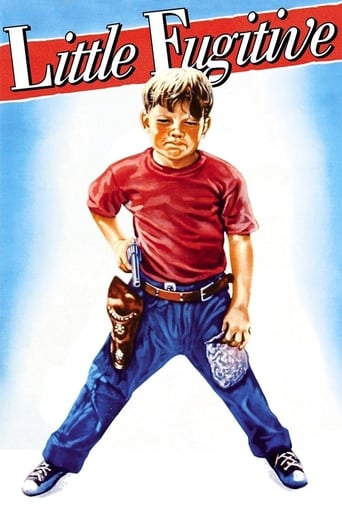
Little Fugitive (1953)
Morris Engel's All-American Classic
After a prank makes Joey Norton believe he killed his older brother, he runs away from home and spends the day at Coney Island while his brother tries to find him before their mother gets home.
- Date of release
- 1953-10-01
- TMDB
- 7.0 / 10 (71)
- Runtime
- 1h 20m
- Genres
- Drama, Family, Adventure
- Director
- Morris Engel, Ray Ashley, Ruth Orkin
Casting
- Richie Andrusco — Joey Norton
- Richard Brewster — Lennie Norton
- Winifred Cushing — Mother
- Jay Williams — Jay the Pony-Ride Man
- Will Lee — Photographer
- Charlie Moss — Harry
- Tommy DeCanio — Charlie
- Ruth Orkin — Woman on beach (uncredited)
Interesting facts
- Awards: 1 · Nominations: 1. Including: National Board of Review: Top Ten Films
Little Fugitive is a 1953 American independent drama film co-written and co-directed by Raymond Abrashkin, Morris Engel, and Ruth Orkin, which tells the story of a child alone on Coney Island. It stars Richie Andrusco as the title character, and Richard Brewster as his older brother. The film was screened at 14th Venice International Film Festival, where it was awarded the Silver Lion, and nominated for Best Writing, Motion Picture Story, at the 26th Academy Awards.
Production notes
The film was filmed on location at Coney Island and in Brooklyn using a unique concealed strap-on camera, which made it possible for Engel to work without a tripod or a large crew and allowed him to have thousands of beach-going New Yorkers as extras without their knowing it.
Engel was an experienced photo-journalist when he was asked in 1939 by his friend Paul Strand to shoot some motion picture film for his film Native Land using the compact 35mm Bell and Howell Eyemo holding 100 foot rolls that could film about one minute of film. But he was disappointed that Strand put this camera designed for hand-holding on a heavy metal baseplate attached to a heavy wooden tripod.
During World War II he was a still photographer but he probably was familiar with a handheld 35 mm battery-operated camera developed during the war for combat photography, the Cunningham Combat Camera. The large square camera was mounted a rifle stock, held tightly to the cameraman's chest by handles mounted on each side, and aimed in the general direction of the action, sighted by a top-mounted viewfinder.
After the war, Engel and an engineer he met in the service, Charles Woodruff, reconfigured the Cunningham camera into a much smaller camera for civilian purposes. Engel explained, "Designed for me, it was a compact 35mm, hand held, shoulder cradled, [with] double registration pins and twin lens finder and optical system." It used the Cunningham 35mm 200 foot interchangeable magazines which met the camera at the film gate with the lens, motor, shu…
Film teacher Joel Schlemowitz says, "The film’s storyline, about a young boy gone on the lam among the boardwalk, beach, and amusements of Coney Island, provided the opportunity to film in situations well matched to this unobtrusive camera's virtues.
Read on Wikipedia · Text from Wikipedia, CC BY-SA 4.0. Data from Wikidata.
Recommended
- Wonder 2017 · ★ 8.1
- Return to Nim's Island 2013 · ★ 6.5
- The Secret Life of Bees 2008 · ★ 7.5
- Iron Will 1994 · ★ 6.7
- The Magic Faraway Tree 2026 · ★ 6.7
- The Darkest Minds 2018 · ★ 7.0
- Lord of the Flies 1963 · ★ 6.7
- Benji 2018 · ★ 6.9
- The Thief Lord 2006 · ★ 6.0
- Dog Gone 2023 · ★ 6.2
- The Young and Prodigious T.S. Spivet 2013 · ★ 6.9
- PAW Patrol: Mighty Pups 2018 · ★ 7.5