小逃亡者 (1953)
Little Fugitive
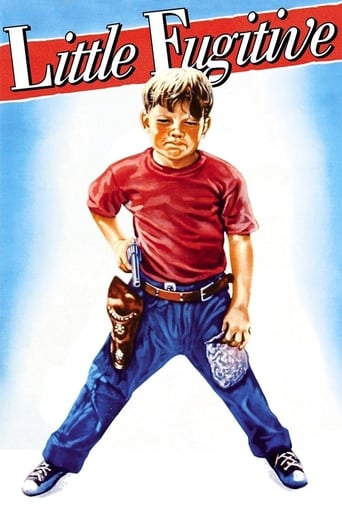
由于母亲要出远门,照顾7岁的弟弟乔伊(Richie Andrusco 饰)的职责便落到了哥哥雷利(Richard Brewster 饰)的肩上,对此感到十分厌烦的雷利想出了一个不仅可以博朋友们一笑,并且可以解自己心头之气的点子。在朋友们的帮助下,雷利通过装死让乔伊误以为是自己杀死了哥哥,没想到,个性耿直的乔伊居然在惊恐之下孤身踏上了逃亡的旅程。 乔伊的目的地是风景如画的科尼岛,然而,从此地到彼处的路程对于一个7岁的男孩来说无疑十分漫长。一路上,乔伊睡沙滩,捡瓶子,通过自己的聪明才智安然无恙的前进着,而另一边,心急如焚的雷利也开始了他寻找乔伊的征程。乔伊能够平安到达科尼岛吗?
- 上映日期
- 1953-10-01
- TMDB
- 7.0 / 10 (72)
- 片长(分钟)
- 1小时20分钟
- 类型
- 剧情, 家庭, 冒险
- 导演
- Morris Engel, Ray Ashley, Ruth Orkin
演员阵容
- Richie Andrusco — Joey Norton
- Richard Brewster — Lennie Norton
- Winifred Cushing — Mother
- Jay Williams — Jay the Pony-Ride Man
- Will Lee — Photographer
- Charlie Moss — Harry
- Tommy DeCanio — Charlie
- Ruth Orkin — Woman on beach (uncredited)
趣闻
- 获奖:1 · 提名:1. 包括:國家評論協會獎:十大佳片
Little Fugitive is a 1953 American independent drama film co-written and co-directed by Raymond Abrashkin, Morris Engel, and Ruth Orkin, which tells the story of a child alone on Coney Island. It stars Richie Andrusco as the title character, and Richard Brewster as his older brother. The film was screened at 14th Venice International Film Festival, where it was awarded the Silver Lion, and nominated for Best Writing, Motion Picture Story, at the 26th Academy Awards.
Production notes
The film was filmed on location at Coney Island and in Brooklyn using a unique concealed strap-on camera, which made it possible for Engel to work without a tripod or a large crew and allowed him to have thousands of beach-going New Yorkers as extras without their knowing it.
Engel was an experienced photo-journalist when he was asked in 1939 by his friend Paul Strand to shoot some motion picture film for his film Native Land using the compact 35mm Bell and Howell Eyemo holding 100 foot rolls that could film about one minute of film. But he was disappointed that Strand put this camera designed for hand-holding on a heavy metal baseplate attached to a heavy wooden tripod.
During World War II he was a still photographer but he probably was familiar with a handheld 35 mm battery-operated camera developed during the war for combat photography, the Cunningham Combat Camera. The large square camera was mounted a rifle stock, held tightly to the cameraman's chest by handles mounted on each side, and aimed in the general direction of the action, sighted by a top-mounted viewfinder.
After the war, Engel and an engineer he met in the service, Charles Woodruff, reconfigured the Cunningham camera into a much smaller camera for civilian purposes. Engel explained, "Designed for me, it was a compact 35mm, hand held, shoulder cradled, [with] double registration pins and twin lens finder and optical system." It used the Cunningham 35mm 200 foot interchangeable magazines which met the camera at the film gate with the lens, motor, shu…
Film teacher Joel Schlemowitz says, "The film’s storyline, about a young boy gone on the lam among the boardwalk, beach, and amusements of Coney Island, provided the opportunity to film in situations well matched to this unobtrusive camera's virtues.
在维基百科阅读更多 · 文本来自维基百科,CC BY-SA 4.0。数据来自 Wikidata。