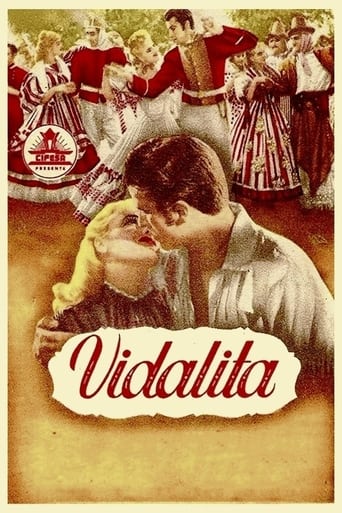
Vidalita (1949)
In 1830, a young orphan lady poses as a man in order to meet the expectations of her uncle.
- Date of release
- 1949-06-17
- TMDB
- 7.0 / 10 (3)
- Runtime
- 1h 26m
- Genres
- Comedy
- Director
- Luis Saslavsky
Casting
- Mirtha Legrand — Vidalita
- Fernando Lamas — Capitán Mariano Sucre
- Amalia Sánchez Ariño — Ama Cruz
- Oscar Valicelli — Laureano Sánchez
- Narciso Ibáñez Menta — Don Hilarion
- Pilar Gómez
- Milagros de la Vega
- Analía Gadé
- Enrique García Satur
- Linda Lorena
- Leticia Scury
- Lucía Barausse
Interesting facts
Vidalita is a 1949 Argentine historical romantic comedy film directed by Luis Saslavsky—who also wrote the story—with a screenplay by Ariel Cortazzo and dialogue by both, produced by the Emelco studio during the classical period of Argentine cinema. Set in 1830, it tells the story of a young woman who cross-dresses as a gaucho to be accepted by her grandfather, who longs for a grandson, and who in her male guise ends up making the captain of a fort fall in love with her. It stars Mirtha Legrand, Narciso Ibáñez Menta, and Fernando Lamas, for whom it was his last film in the country.
Production and style
The production company Emelco, specialized in advertising and newsreel cinema and headed by the businessman Kurt Löwe, entered feature-film production in 1946—within the framework of the classical-industrial period of Argentine cinema—after acquiring the studios of the bankrupt Pampa Film.
Luis Saslavsky occupied a complex place within Argentine cinema. He had trained in Paris and started out as a film critic and correspondent in Hollywood, and began his career as a director in the 1930s, at the height of the emergence of sound film and the accelerated industrial growth of the Golden Age, which gave rise to new debates about national cinema in which he also took part.
Vidalita was conceived as a folkloric operetta in a mocking tone, with characters who speak in verse. According to Domingo Di Núbila, Saslavsky's idea was to "transplant the Spanish zarzuela to the pampa" and employ folkloric elements, as a reaction against the "false gauchismo" of other films set in rural settings.
Vidalita is one of the films by Saslavsky in which the influence of the director Josef von Sternberg—whom he had interviewed in Hollywood and admired for his baroque style—appears most strongly. That influence is evident in the film's scenes of carnivals, dances, and masks, which serve Saslavsky to "hide plots and characters." From a narrative standpoint, Vidalita alters the usual chronological order of the classical model: it opens with a male v…
Read on Wikipedia · Text from Wikipedia, CC BY-SA 4.0. Data from Wikidata.
Recommended
- One Night at McCool's 2001 · ★ 5.9
- Chinese Take-Away 2011 · ★ 7.3
- Louis C.K.: Ridiculous 2026 · ★ 6.1
- Crazy Magical Mexico 2026 · ★ 7.6
- Super Crazy 2018 · ★ 6.7
- No manches, Frida 2: paraíso destruido 2019 · ★ 7.9
- Macho 2016 · ★ 5.9
- 7 Days 2005 · ★ 7.6
- The Family Jewels 1965 · ★ 6.5
- Jackass Presents: Bad Grandpa 2013 · ★ 6.2
- Bendita Suegra 2023 · ★ 8.4
- Perdiendo mi virginidad 2 2022 · ★ 6.6