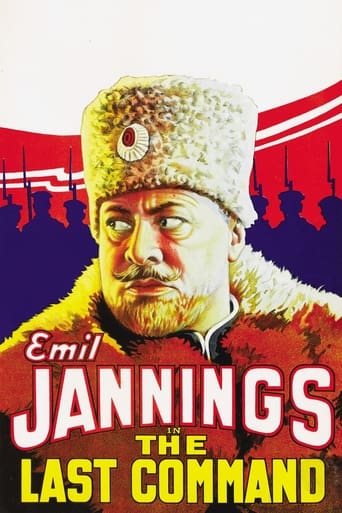
The Last Command (1928)
A former Imperial Russian general and cousin of the Czar ends up in Hollywood as an extra in a movie directed by a former revolutionary.
- Date of release
- 1928-01-21
- TMDB
- 7.3 / 10 (100)
- Runtime
- 1h 28m
- Genres
- Drama, History, War
- Director
- Josef von Sternberg
Casting
- Emil Jannings — Gen. Dolgorucki / Grand Duke Sergius Alexander
- Evelyn Brent — Natalie Dabrova
- William Powell — Lev Andreyev
- Jack Raymond — Assistant director
- Nicholas Soussanin — The adjutant
- Michael Visaroff — Serge (the valet)
- Fritz Feld — A revolutionist
- Harry Cording — Revolutionist (uncredited)
- Shep Houghton — Russian Youth (uncredited)
- Alexander Ikonnikov — Drillmaster (uncredited)
- Nicholas Kobliansky — Drillmaster (uncredited)
- Guy Oliver — Wardrobe Attendant (uncredited)
Interesting facts
- Awards: 1 · Nominations: 2. Including: Academy Award for Best Actor
The Last Command is a 1928 American silent romantic drama film directed by Josef von Sternberg, and written by John F. Goodrich and Herman J. Mankiewicz from a story by Lajos Bíró. The film stars Emil Jannings, who won the first Academy Award for Best Actor in a Leading Role at the 1929 ceremony for his performances in this film and The Way of All Flesh, the only year multiple roles were considered. Evelyn Brent and William Powell co-star.
Production
In 1927, Paramount’s sister film company in Germany, Ufa, yielded its foremost actor Emil Jannings and producer Erich Pommer to make a number of movies in Hollywood. Sternberg and Jannings had established a friendly rapport when they met in Berlin in 1925.
Jannings starred in director Ernst Lubitsch’s The Patriot and in Victor Fleming’s The Way of All Flesh, but his performance in The Last Command surpassed these two productions.
The source of the script for the film has been termed “somewhat controversial”. Paramount attributed the original story entitled “The General” to screenwriter Lajos Bíró, the scenario to John S. Goodrich, and the titles to Herman J. Mankiewicz. Nevertheless, Sternberg's significant additions and alterations to the plot are “incontestable” and form the basis of his claim to “ultimate authorship” of this cinematic "masterpiece."
The Last Command was among “the most ambitious Sternberg ever shot”. The shooting was completed in five weeks.
The release of The Last Command was stalled when Paramount executives reviewed the film and discovered that Sternberg had inserted material portraying Hollywood as heartless and cynical. They further complained that he had historically misrepresented the Russian Revolution, including "recognizable portraits of Trotsky and the young Stalin". Only under duress from a wealthy Paramount stockholder did the studio relent and distribute the film.
Read on Wikipedia · Text from Wikipedia, CC BY-SA 4.0. Data from Wikidata.
Recommended
- Britannic 2000 · ★ 6.8
- The Last Rifleman 2023 · ★ 6.6
- Nicholas and Alexandra 1971 · ★ 7.0
- The Birth of a Nation 1915 · ★ 5.9
- The Scarlet and the Black 1983 · ★ 7.1
- Gods and Generals 2003 · ★ 6.4
- The Charge of the Light Brigade 1968 · ★ 6.2
- Operation Mincemeat 2022 · ★ 6.5
- A Call to Spy 2020 · ★ 6.8
- Zulu 1964 · ★ 7.4
- K-19: The Widowmaker 2002 · ★ 6.6
- The Dam Busters 1955 · ★ 6.9