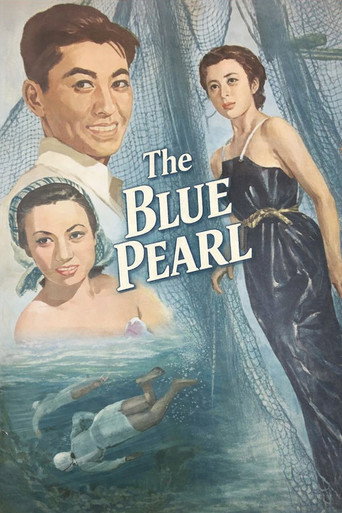
The Blue Pearl (1951)
青い眞珠
The Blue Pearl depicts the interplay between a young man from Tokyo and two ama (pearl divers; literally “women of the sea”) in a superstitious coastal town. Though raised within the same tradition-bound crucible, the two women – Noe and Riu – are portrayed as diametric opposites; the former meek but affectionate, the latter strong-willed but jaded by a tryst with metropolitan life.
- Date of release
- 1951-08-03
- TMDB
- 7.5 / 10 (2)
- Runtime
- 1h 37m
- Genres
- Drama, Romance
- Director
- Ishirō Honda
Casting
- Ryō Ikebe — Nishida
- Yukiko Shimazaki — Noe
- Yuriko Hamada — Riu
- Takashi Shimura — Fujiki
- Reizaburo Yamamoto
- Kan Yanagiya — Shintaro
- Bokuzen Hidari — Riu's father
- Kokuten Kōdō — Noe's uncle
- Yuriko Hanabusa
- Noriko Honma — Riu's mother
- Eiko Miyoshi — Noe's aunt
- Masako Ōshiro
Interesting facts
Aoi Shinju is a 1951 Japanese film directed by Ishirō Honda, his first feature film. The story is based on Umi no haien. It is about a pearl divers and is filmed in a semi-documentary style. The film was produced and distributed by Toho Co., Ltd in Japan on August 3, 1951.
Production
The project was inspired by Honda's experiences filming Ise-Shima and was suggested by Honda's friend Sojiro Motoki, one of Japan's leading film producers at the time. Honda left with Akira Kurosawa to an inn at Atami for a writing retreat. Honda and Motoki chose to adapt Katsuro Yamada's prize winning novella Ruins of the Sea as the basis for the film.
Toho gave Honda three months to scout locations and conduct research on the Ise-Shima area due to the post-strike slowdown. Honda became a familiar face with the locals and was granted access not usually given to tourists.
The film is notable for being the first Japanese feature film to feature underwater photography. Cinematographer Tadashi Iimura placed a portable camera onto a metallic body that acted as a special waterproof device. With it under his arms, he dove into the water from a pontoon. Iimura also had two professional divers to assist with the camera.
Read on Wikipedia · Text from Wikipedia, CC BY-SA 4.0. Data from Wikidata.
Recommended
- It Feels So Good 2019 · ★ 6.6
- Radiance 2017 · ★ 6.5
- Not Easily Broken 2009 · ★ 6.3
- The Secret: Dare to Dream 2020 · ★ 7.4
- Love Everlasting 2016 · ★ 7.4
- Racing with the Moon 1984 · ★ 6.3
- Ali and Nino 2016 · ★ 6.5
- Madame Bovary 1949 · ★ 6.7
- Maria's Lovers 1984 · ★ 6.0
- Forever First Love 2020 · ★ 7.0
- I'm in Love with a Church Girl 2013 · ★ 5.9
- Hello, Goodbye, and Everything in Between 2022 · ★ 6.1