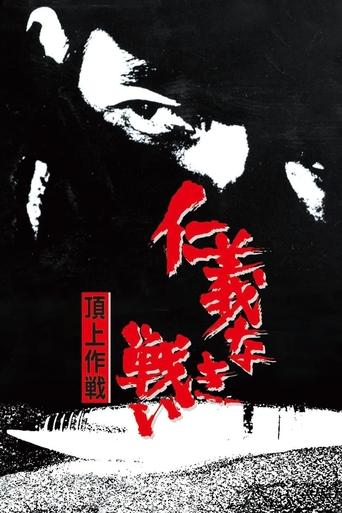
Batallas sin honor ni humanidad, Vol. 4: Tacticas policiales (1974)
仁義なき戦い 頂上作戦
Tácticas policiales
Cuarta entrega de la saga "Batallas sin honor ni humanidad" de Kinji Fukasaku. En esta ocasión los grupos yakuza se verán cercados por la policía y la prensa, debido a las protestas sociales de ciudadanos de a pie en contra de los altos niveles de violencia callejera que se vivían en ciertas ciudades japonesas durante la década de los 60.
- Fecha de estreno
- 1974-01-15
- TMDB
- 7.0 / 10 (51)
- Duración
- 1 h 41 min
- Géneros
- Crimen, Drama, Acción
- Director
- Kinji Fukasaku
- Colección
- The Yakuza Papers - Colección
Reparto
- Bunta Sugawara — Shozo Hirono
- 梅宮辰夫 — Shinichi Iwai
- 黒沢年雄 — Shigeru Takemoto
- 田中邦衛 — Masakichi Makihara
- 山城新伍 — Shoichi Eda
- 小倉一郎 — Hiroshi Nozaki
- 長谷川明男 — Yasuki Fukuda
- 三上真一郎 — Hidemitsu Kawada
- Isao Natsuyagi — Hiroshi Sugimoto
- 堀越陽子 — Aiko Mitsukawa
- 木村俊恵 — Toshika
- 中原早苗 — Kikue
Curiosidades
Battles Without Honor and Humanity: Police Tactics is a 1974 Japanese yakuza film directed by Kinji Fukasaku. It is the fourth film in a five-part series that Fukasaku made in a span of just two years.
Production
Due to the success of the first film, Toei demanded that screenwriter Kazuo Kasahara finally write about the Hiroshima yakuza war depicted in Kōichi Iiboshi's articles, which are themselves based on the journals of Kōzō Minō, and split it into two films.
The fourth film began in September 1973. Set after the Hiroshima incidents, Hirono and the lead characters are now high-ranking bosses that do not appear in the battles themselves. Therefore, Kasahara and director Kinji Fukasaku decided to show the violent story from multiple angles in an objective way.
During his fifth visit to Hiroshima Kasahara found that both Minō and Takeshi Hattori, second president of the Kyosei-kai, enjoyed talking about their successful predecessors, but the former bosses refused to talk about the young gangsters that were killed or that committed the murders. So the writer asked the police for information, but they declined as well.
Kasahara collected all his information into a large collage of all the gang fights, but having worked on the series for a year, began to lose sight of what he was doing. Toei was telling him to hurry up, follow the budget, and make it more entertaining. He cited reading a collection of essays by poet Sumita Oyama called "Human Adoration" as the only thing that kept him sane. The screenplay took him 73 days to write.
Leer en Wikipedia · Texto de Wikipedia, CC BY-SA 4.0. Datos de Wikidata.
Recomendadas
- Batallas sin honor ni humanidad, Vol. 5: Episodio Final 1974 · ★ 7.2
- The Blood of Wolves 2018 · ★ 7.2
- Outrage 2 2012 · ★ 7.0
- Batallas sin honor ni humanidad, Vol. 3: Guerra subsidiaria 1973 · ★ 7.0
- Outrage 3 2017 · ★ 6.8
- Batallas sin honor ni humanidad 1973 · ★ 7.3
- Outrage 2010 · ★ 6.9
- La juventud de la bestia 1963 · ★ 6.9
- Una familia 2021 · ★ 7.4
- Black Rain 1989 · ★ 6.6
- Lady Snowblood 1973 · ★ 7.5
- Yakuza 1974 · ★ 7.1