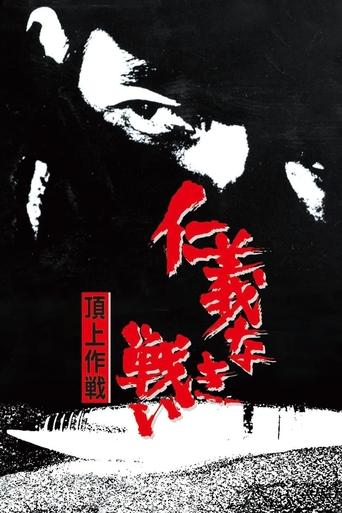
无仁义之战4:顶上作战 (1974)
仁義なき戦い 頂上作戦
昭和38年,明石组系与神和会系两派发动的广岛战争愈演愈烈,期间不断有无辜市民遇害。受舆论和民众的巨大压力,警方动员所有力量,发动名为“顶上作战”的打击黑势力的行动。广能昌三(菅原文太 饰)为壮大实力,说服中立派义西会会长冈岛友次(小池朝雄 饰)加入明石一派。同时,广能组干部河西清(八名信夫 饰)被刺,双方战争扩大化,袭击事件频发。明石组岩井(梅宫辰夫 饰)出计借河西葬礼之际集结西日本同盟,给山守组突然袭击。然计划被打本(加藤武 饰)泄漏,山守义雄(金子信雄 饰)向警方检举,广能被捕。之后广能组成员遇袭、冈岛被刺等一系列事件使明石一派处于劣势。但很快义西会干部藤田正一(松方弘树 饰)填补空缺,和山守组少壮派武田明(小林旭 饰)展开新一轮对抗。而警方针对所有黑帮干部的行动也同时开始……
演员阵容
- 菅原文太 — Shozo Hirono
- 梅宫辰夫 — Shinichi Iwai
- 黑泽年雄 — Shigeru Takemoto
- 田中邦卫 — Masakichi Makihara
- 山城新伍 — Shoichi Eda
- 小仓一郎 — Hiroshi Nozaki
- 长谷川明男 — Yasuki Fukuda
- 三上真一郎 — Hidemitsu Kawada
- 夏八木勋 — Hiroshi Sugimoto
- 堀越陽子 — Aiko Mitsukawa
- 木村俊恵 — Toshika
- 中原早苗 — Kikue
趣闻
Battles Without Honor and Humanity: Police Tactics is a 1974 Japanese yakuza film directed by Kinji Fukasaku. It is the fourth film in a five-part series that Fukasaku made in a span of just two years.
Production
Due to the success of the first film, Toei demanded that screenwriter Kazuo Kasahara finally write about the Hiroshima yakuza war depicted in Kōichi Iiboshi's articles, which are themselves based on the journals of Kōzō Minō, and split it into two films.
The fourth film began in September 1973. Set after the Hiroshima incidents, Hirono and the lead characters are now high-ranking bosses that do not appear in the battles themselves. Therefore, Kasahara and director Kinji Fukasaku decided to show the violent story from multiple angles in an objective way.
During his fifth visit to Hiroshima Kasahara found that both Minō and Takeshi Hattori, second president of the Kyosei-kai, enjoyed talking about their successful predecessors, but the former bosses refused to talk about the young gangsters that were killed or that committed the murders. So the writer asked the police for information, but they declined as well.
Kasahara collected all his information into a large collage of all the gang fights, but having worked on the series for a year, began to lose sight of what he was doing. Toei was telling him to hurry up, follow the budget, and make it more entertaining. He cited reading a collection of essays by poet Sumita Oyama called "Human Adoration" as the only thing that kept him sane. The screenplay took him 73 days to write.
在维基百科阅读更多 · 文本来自维基百科,CC BY-SA 4.0。数据来自 Wikidata。