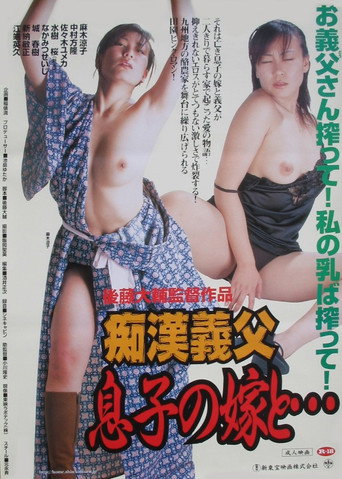
Les larmes d’une vache (2003)
痴漢義父 息子の嫁と…
Une jeune veuve, Noriko, vit avec son beau-père sénile, Shukichi, dans une ferme isolée. Ce dernier croit que sa vache préférée, disparue depuis longtemps, est toujours en vie. Noriko fait semblant d'être la vache et le laisse la traire - un arrangement satisfaisant pour tous les deux.
- Date de sortie
- 2003-04-08
- TMDB
- 4.8 / 10 (35)
- Durée
- 1 h 1 min
- Genres
- Drame, Romance
- Réalisateur
- Daisuke Gotô
Distribution
- 中村方隆 — Syukichi
- Ryôko Asagi — Noriko
- 佐々木ユメカ — Mitsuko
- なかみつせいじ — Hajime
- イ美月桜 — Chiriko
- 城春樹 — Doctor
- 新納敏正 — Haruki
- 堀本能礼 — Patient
Anecdotes
A Lonely Cow Weeps at Dawn aka A Cow at Daybreak and Cowshed of Immorality (2003) is a Japanese pink film directed by Daisuke Gotō and starring Ryōko Asagi and Horyu Nakamura. It has been shown in film festivals, and was named the fifth best pink film released in the year 2003.
Production and critical reception
Director Daisuke Gotō cites Yasujirō Ozu's Late Spring (1949) and Bernardo Bertolucci's 1900 (1976) as influences on A Lonely Cow Weeps at Dawn. The film was screened at the 2004 New School of Pink-Movies, a showcase for the younger "Seven Lucky Gods of Pink" (ピンク七福神, shichifukujin) generation of pink film makers.
American audiences first saw A Lonely Cow Weeps at Dawn at the Fantastic Fest in Austin, Texas in September 2008. In his Behind the Pink Curtain: The Complete History of Japanese Sex Cinema (2008), pink film authority Jasper Sharp writes A Lonely Cow Weeps at Dawn is, "pink film at its most inventive, albeit frankly bewildering."
The British site, DVDTimes, writes that A Lonely Cow Weeps at Dawn is "a film of bittersweet sentiments, which credibly deals with loneliness, greed and the coming to terms with old age." The site judges Hajime Oba's musical soundtrack as "beautifully poignant", and the cinematography, "keeps things visually alluring, with the Japanese countryside providing a pleasant change of pace."
Lire sur Wikipédia · Texte de Wikipédia, CC BY-SA 4.0. Données de Wikidata.
Recommandés
- The Duke of Burgundy 2015 · ★ 6.3
- Cinquante nuances plus claires 2018 · ★ 6.7
- Tokyo décadence 1992 · ★ 6.0
- Newness 2017 · ★ 6.1
- L'Homme d'Elysian Fields 2001 · ★ 5.9
- Cinquante Nuances de Grey 2015 · ★ 5.9
- Below Her Mouth 2017 · ★ 6.8
- It Feels So Good 2019 · ★ 6.6
- Female yakuza tale 1973 · ★ 6.1
- L'Empire des sens 1976 · ★ 6.6
- Infidèle 2002 · ★ 6.7
- Cinquante nuances plus sombres 2017 · ★ 6.5