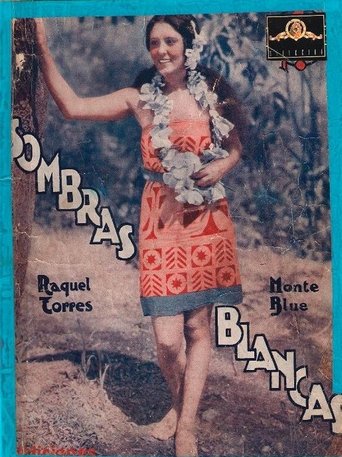
Sombras blancas en los mares del sur (1928)
White Shadows in the South Seas
En una isla polinesia, un médico alcohólico, profundamente disgustado por la explotación de los nativos a manos de los blancos, se encuentra a sí mismo abandonado en una isla paradisíaca.
- Fecha de estreno
- 1928-11-11
- TMDB
- 6.7 / 10 (27)
- Duración
- 1 h 28 min
- Géneros
- Romance, Aventura, Drama
- Director
- W.S. Van Dyke
Reparto
- Monte Blue — Dr. Matthew Lloyd
- Raquel Torres — Fayaway
- Robert Anderson — Sebastian
- Renee Bush — Lucy
- Napua — Native Boy
- Dorothy Janis — Girl
Curiosidades
- Rodada en: Tahití
- Premios: 1 · Nominaciones: 1. Incluyendo: Óscar a la mejor fotografía
White Shadows in the South Seas is a 1928 American synchronized sound romantic adventure film directed by W.S. Van Dyke and starring Monte Blue and Raquel Torres. It was produced by Cosmopolitan Productions in association with Metro-Goldwyn-Mayer, who distributed the film. While the film has no audible dialog, it was released with a synchronized musical score with sound effects using the sound-on-film Western Electric Sound System process. Loosely based on the travel book of the same name by Frederick O'Brien, this film is important historically for being the first sound MGM film to be released with a pre-recorded soundtrack. Clyde De Vinna won an Academy Award for Best Cinematography.
Production history
The film is inspired by the 1919 travel book of the same name by Frederick O'Brien, who spent a year in the South Pacific with Marquesas Islanders. The film began production in 1927 as a co-venture between documentary filmmaker Robert Flaherty, Cosmopolitan, and MGM. The production was filmed in Tahiti, some 4000 miles from Hollywood, a rarity for the time.
The film is known for being the first MGM film to be released with a pre-recorded soundtrack. The soundtrack consisted of a romantic score by William Axt and David Mendoza, with a few sound effects such as wind howling, a storm, trees ruffling, and the words "hello" and "wait." The Tahitian location was sumptuously captured by cameramen Clyde De Vinna, Bob Roberts, and George Nogle.
Frederick O'Brien had spent a year on Hiva Oa prior to the publication of his 1919 book, living amongst native Marquesan islanders. Robert Flaherty had lived with his wife and children in Samoa from April 1923 to December 1924 filming the feature documentary Moana released in January 1926 by Paramount Pictures.
Several years later, MGM production head Irving Thalberg, while recuperating during a hospital stay, read O'Brien's book. In 1927 Thalberg decided to film O'Brien's book. Flaherty, a friend of O'Brien's, was brought aboard as director while W. S. Van Dyke was added as support to Flaherty. The production would head to Papeete, Tahiti.
The new film would feature a supporting cast consisting of almost all Tahitian islanders and actors, with only the featured stars and a few heavies or villains coming from Hollywood. Flaherty, upon arriving in Tahiti, began shooting the film at a slow pace which was not practical for MGM. After clashing with Van Dyke, Flaherty left the production, leaving Van Dyke as sole director for the film. Van Dyke then finished the project on schedule.
Leer en Wikipedia · Texto de Wikipedia, CC BY-SA 4.0. Datos de Wikidata.
Recomendadas
- Tabú 1931 · ★ 7.1
- El lago azul 1980 · ★ 6.1
- Robinson Crusoe por un año 1986 · ★ 6.3
- Huracán sobre la isla 1937 · ★ 6.7
- Robinson Crusoe 1997 · ★ 6.0
- El piano 1993 · ★ 7.4
- Náufrago 2000 · ★ 7.7
- El lago azul: El despertar 2012 · ★ 6.4
- Los mares de China 1935 · ★ 6.3
- Volver a Hawai 2000 · ★ 6.3
- El hombre que vino del mar 1998 · ★ 6.4
- La senda de los elefantes 1954 · ★ 5.9