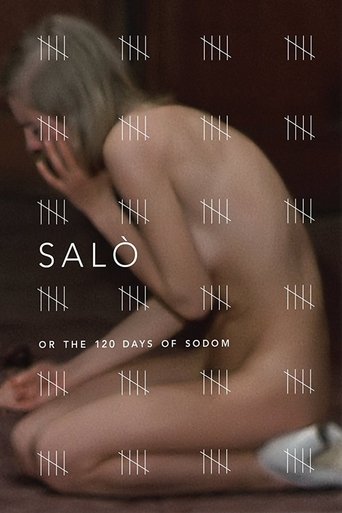
Salò, or the 120 Days of Sodom (1976)
Salò o le 120 giornate di Sodoma
The final vision of a controversial filmmaker.
Four corrupted fascist libertines round up 9 teenage boys and girls and subject them to 120 days of sadistic physical, mental and sexual torture.
- Date of release
- 1976-01-10
- TMDB
- 6.3 / 10 (2423)
- Runtime
- 1h 57m
- Genres
- Horror, Drama
- Director
- Pier Paolo Pasolini
Casting
- Paolo Bonacelli — The Duke
- Giorgio Cataldi — The Bishop
- Uberto Paolo Quintavalle — The Magistrate
- Aldo Valletti — The President
- Caterina Boratto — Signora Castelli
- Elsa De Giorgi — Signora Maggi
- Hélène Surgère — Signora Vaccari
- Sonia Saviange — The Pianist
- Sergio Fascetti — Sergio
- Bruno Musso — Carlo Porro
- Antonio Orlando — Tonino
- Claudio Cicchetti — Male Victim
Interesting facts
- Based on: The 120 Days of Sodom
- Filmed in: Salò, Cinecittà, Bologna, Gardeletta, and Villa Riesenfeld
Salò, or the 120 Days of Sodom, billed on-screen as Pasolini's 120 Days of Sodom on English-language prints and commonly referred to as simply Salò, is a 1975 political art horror film directed and co-written by Pier Paolo Pasolini. The film is a loose adaptation of the 1785 novel The 120 Days of Sodom by the Marquis de Sade, updating the story's setting to Italy during World War II. It was the writer–director's final film, released three weeks after Pasolini's murder.
Production
Pasolini's writing collaborator Sergio Citti had originally been attached to direct the intended adaptation of the Marquis de Sade's The 120 Days of Sodom. During the creation of the first drafts of the script, Pasolini called upon several of his usual collaborators, among them Citti, Claudio Masenza, Antonio Troisi and especially Pupi Avati.
While collaborating with Citti on the script, Pasolini was compelled to transpose the setting of Salò from 18th-century France (as depicted in de Sade's original book) to the last days of Benito Mussolini's Republic of Salò in the spring of 1944. Salò is a toponymical metonymy for the Italian Social Republic (because Mussolini ruled from this northern town rather than from Rome), which was a puppet state of Nazi Germany.
In the film, almost no background is given on the tortured subjects and, for the most part, they almost never speak. Pasolini's depiction of the victims in such a manner was intended to demonstrate the physical body "as a commodity...
Interior design was chosen to feature paintings and art by artists such as Severini, Duchamp, and Feininger. Pasolini also stated that the four fascist libertines were written as highly educated characters and were to refer to themes brought up by, among others, Blanchot, Nietzsche, and Klossowski.
In contrast to his "Trilogy of Life" (Il Decameron, I racconti di Canterbury and Il fiore delle Mille e una notte), Pasolini initially planned The 120 days of Sodom and Salò as separate stories, but noting similarity between both concepts – and based on their experiences in the Republic of Salò – conceived the idea of Salò or the 120 Days of Sodom.
Read on Wikipedia · Text from Wikipedia, CC BY-SA 4.0. Data from Wikidata.
Recommended
- The Devils 1971 · ★ 7.5
- The Girl Next Door 2007 · ★ 6.6
- Ghostland 2018 · ★ 7.4
- The Woman 2011 · ★ 6.1
- Late Night Trains 1975 · ★ 6.1
- Hellbound: Hellraiser II 1988 · ★ 6.4
- Mother's Day 2010 · ★ 6.5
- Mudhoney! 1965 · ★ 6.2
- God Is a Bullet 2023 · ★ 6.3
- Antichrist 2009 · ★ 6.6
- Brimstone 2016 · ★ 7.1
- Day of the Woman 1978 · ★ 6.0