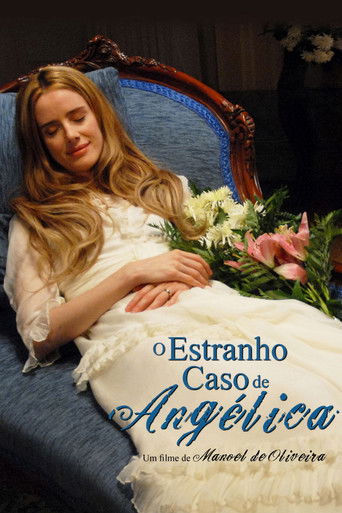
O Estranho Caso de Angélica (2010)
A photographer, Isaac, is asked by hotel owners to take portraits of their recently deceased daughter Angélica. When he looks at her through the lens of his camera, she appears to come back to life just for him. He instantly falls in love with her. From that moment, he will be haunted by Angélica day and night.
- Data lansării
- 2010-12-29
- TMDB
- 6.5 / 10 (65)
- Durată
- 1 h 37 min
- Genuri
- Dramă, Fantasy, Romantic
- Regizor
- Manoel de Oliveira
Distribuție
- Pilar López de Ayala — Angélica
- Leonor Silveira — Mãe
- Filipe Vargas — Marido
- Ricardo Trêpa — Isaac
- Paulo Matos — Homem da Gabardine
- Luís Miguel Cintra — Engenheiro
- Ana Maria Magalhães — Clementina
- Isabel Ruth — Criada
- Ricardo Aibéo — Mendigo
- Sofia de Portugal — Enfermeira
- Susana Sá — D. Rosa
- Carmen Santos — Mulher do Fotógrafo
Curiozități
The Strange Case Of Angelica is a 2010 Portuguese supernatural psychological romantic drama film written and directed by Manoel de Oliveira. Conceived in 1946 and initially written in 1952, it was updated with modern elements by the 2000s. It follows the Jewish photographer Isaac, who after attending the funeral of Angélica, a beautiful deceased young bride, begins to be haunted by her image.
Production
During the long hiatus Oliveira entered after Aniki-Bóbó (1942), Maria Antónia, a cousin of his wife, died days after her wedding. The event inspired the initial idea, turned into a screenplay by 1952 entitled Angélica.
The narrative was originally conceived as a response to the World War II, as the character Isaac would be a Jewish Holocaust refugee photographer who had recently arrived in Portugal. The script featured discussions about the persecution of Jews in Portugal and the origins of antisemitism.
Angélica was one of Manoel de Oliveira's projects whose funding was repeatedly denied, forcing him into a 14-year hiatus until The Artist and the City (1956). Oliveira submitted the project to the Secretariado Nacional de Informação, the censorship body of the Salazar regime (Estado Novo). The filmmaker never received a response. He later considered that "A story like this had nothing to please the regime.
In 1988, the Cinemateca Portuguesa (Lisbon) published "Some unrealized projects and other texts - Manoel de Oliveira", which includes the screenplay of Angélica, among others, such as Bruma (1931), Os Gigantes do Douro (1934), Prostituição (1940) and Saltimbancos (1944).
The screenplay was also published in France under the title "Angélica (1954): Un découpage" in 1993. An English language translation was published in 1998. In the preface to this edition, Oliveira describes how Maria Antónia's death inspired the narrative: "We received a phone call […] informing us that Maria Antónia had felt unwell.
Citește pe Wikipedia · Text din Wikipedia, CC BY-SA 4.0. Date din Wikidata.
Recomandate
- Peter Ibbetson 1935 · ★ 7.0
- Poveste de iarnă 2014 · ★ 6.3
- Wicked 2021 · ★ 7.8
- The Future 2011 · ★ 5.9
- Veșnic împreună 2020 · ★ 6.6
- Nouă zile 2021 · ★ 6.8
- Blind 2017 · ★ 6.1
- Căzut din cer 2016 · ★ 6.1
- Donovan's Echo 2011 · ★ 6.0
- Sahara 1983 · ★ 5.9
- Ultima speranță 2023 · ★ 7.0
- Heart of the Country 2013 · ★ 6.2