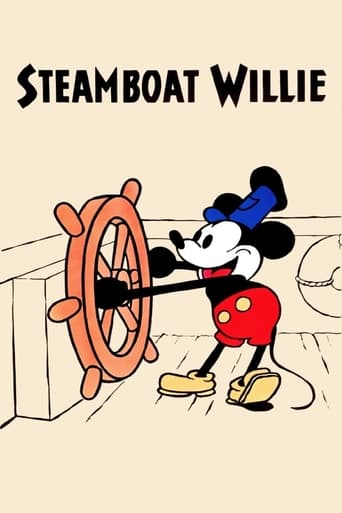
Steamboat Willie (1928)
Mickey Mouse, piloting a steamboat, delights his passenger, Minnie Mouse, by making musical instruments out of the menagerie on deck.
Casting
- Walt Disney — Mickey Mouse / Minnie Mouse / Pete (voice) (uncredited)
Interesting facts
- Based on: Steamboat Bill Jr.
Steamboat Willie is a 1928 American animated short film directed by Walt Disney and Ub Iwerks. It was produced in black-and-white by Disney Cartoons and was released by Pat Powers' Celebrity Productions. The cartoon is considered the official debut of Mickey Mouse and Minnie Mouse, although both appeared months earlier in a test screening of Plane Crazy and the then-unreleased The Gallopin' Gaucho. Steamboat Willie is the third film in the Mickey Mouse series to have been produced, but it is the first to have been officially distributed, because Disney had seen The Jazz Singer (1927) and became determined to produce one of the first fully synchronized sound cartoons.
Production
Steamboat Willie was produced between July and September 1928, which according to Roy O. Disney's personal notes had a budget of US$4,986.69 (equivalent to about $94,000 in 2025), including the prints for movie theaters. There was initially some doubt among the animators that a sound cartoon would appear believable enough, so before a soundtrack was produced, Disney arranged for a screening of the film to a test audience with live sound to accomp…
The audience's response was extremely positive, and it gave Walt Disney the confidence to move forward and complete the film. He recalled this first viewing: "The effect on our little audience was nothing less than electric. They responded almost instinctively to this union of sound and motion. I thought they were kidding me. So they put me in the audience and ran the action again.
Walt Disney traveled to New York City to hire a company to produce the soundtrack, since no such facilities existed in Los Angeles. He eventually settled on Pat Powers's Cinephone system, created by Powers using a bootlegged and updated version of Lee De Forest's Phonofilm system.
The music in the final soundtrack was performed by the Green Brothers Novelty Band and was conducted by Carl Edouarde. Joe and Lew Green from the band also assisted in timing the music to the film. The first attempt to synchronize the recording with the film, done on September 15, 1928, was a disaster. Disney had to sell his Moon roadster in order to finance a second recording.
Read on Wikipedia · Text from Wikipedia, CC BY-SA 4.0. Data from Wikidata.
Recommended
- Plane Crazy 1929 · ★ 6.4
- Thru the Mirror 1936 · ★ 7.2
- Ye Olden Days 1933 · ★ 6.4
- Get a Horse! 2013 · ★ 7.5
- The Barn Dance 1929 · ★ 5.9
- The Gruffalo 2009 · ★ 7.4
- Bath Day 1946 · ★ 6.4
- Clock Cleaners 1937 · ★ 7.1
- The Wonderful World of Mickey Mouse: Steamboat Silly 2023 · ★ 6.9
- Hawaiian Holiday 1937 · ★ 6.7
- The Big Bad Wolf 1934 · ★ 6.5
- Daffy Duck's Movie: Fantastic Island 1983 · ★ 6.7