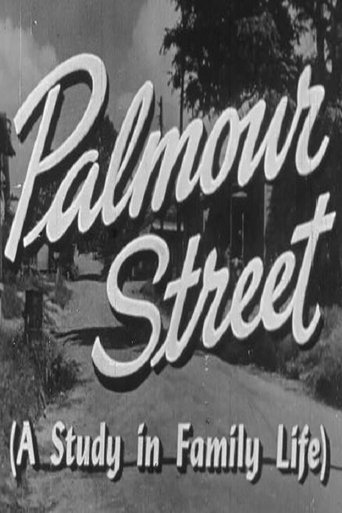
Palmour Street (A Study in Family Life) (1949)
Neorealist mental health film produced for parents and health care workers. Palmour Street shows the daily life of an African American family and demonstrates how good parenting prepares children for adulthood and nurtures emotional growth.
- Date de sortie
- 1949-01-01
- Durée
- 25 min
- Genres
- Drame
- Réalisateur
- Bill Clifford, George C. Stoney
Anecdotes
- Tourné à : Gainesville metropolitan area
Palmour Street, A Study of Family Life (1949) is a short black and white documentary film written, produced and directed by the prolific filmmaker and "father of Public Access Television", George C. Stoney, and his collaborator Bill Clifford. Premiering at the old Fair Street School in Gainesville, Georgia, the film's purpose was to promote the growth of the African American middle class.
Production
Film production took place at the unpaved 511 Palmour Street in Gainesville, Georgia in the middle of Gainesville's African American community. No longer in existence, Palmour Street was located between Gainesville's Center Street and College Avenue.
As he also would do with his Georgia production of his All My Babies documentary film in 1953, Stoney partnered with local Hall County, Georgia-based African American physicians, Dr. William Alfred Mason and Dr. Emmett Ethridge Butler, to gain the trust of the black community. Stoney worked closely with the Hall County Health Department to gain trust from the local white community.
The actual residents of 511 Palmour Street, James Wesley Merritt (better known as "Wes Merritt"), his wife Mrs. Mildred Moss Merritt, and their four children, played the role of the fictitious Vernon Rogers family.
Lire sur Wikipédia · Texte de Wikipédia, CC BY-SA 4.0. Données de Wikidata.
Recommandés
- La Fracture 2021 · ★ 6.6
- Juliette au printemps 2024 · ★ 6.8
- What Maisie Knew 2013 · ★ 7.1
- The Sound of Silence 2019 · ★ 5.9
- Eleanor the Great 2025 · ★ 6.8
- Vincent, François, Paul… et les autres 1974 · ★ 7.0
- Come Sunday 2018 · ★ 5.8
- La Nouvelle Vie de Paul Sneijder 2016 · ★ 6.0
- Les Promesses 2022 · ★ 6.3
- The Last of England 1987 · ★ 6.0
- Éloge de l'amour 2001 · ★ 6.5
- Merci la vie 1991 · ★ 6.2