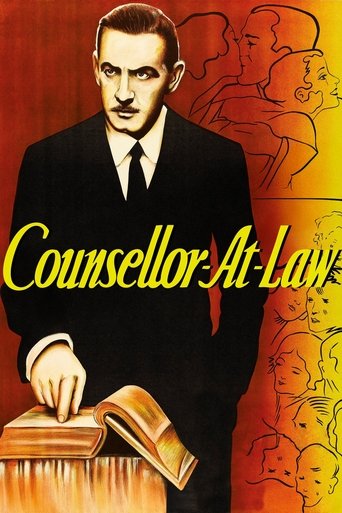
Counsellor at Law (1933)
Great is the word for...COUNSELLOR AT LAW!
A successful lawyer struggles to deal with his wife's unfaithfulness and his own hidden past.
- Date of release
- 1933-12-25
- TMDB
- 6.6 / 10 (30)
- Runtime
- 1h 22m
- Genres
- Drama
- Director
- William Wyler
Casting
- John Barrymore — George Simon
- Bebe Daniels — Regina 'Rexy' Gordon
- Doris Kenyon — Cora Simon
- Isabel Jewell — Bessie Green
- Melvyn Douglas — Roy Darwin
- Onslow Stevens — John P. Tedesco
- Thelma Todd — Lillian La Rue
- Clara Langsner — George Simon's Mother
- John Hammond Dailey — Charlie McFadden
- Mayo Methot — Zedorah Chapman
- Angela Jacobs — Goldie
- Robert Gordon — Henry Susskind
Interesting facts
- Based on: Counsellor-at-Law
Counsellor at Law is a 1933 American pre-Code drama film directed by William Wyler. The screenplay by Elmer Rice is based on his 1931 Broadway play of the same title.
Production
After directing a series of films he considered inconsequential, William Wyler was happy to be assigned to a prestigious project based on a play that had enjoyed successful runs on Broadway and in Chicago, Los Angeles, and San Francisco. Producer Carl Laemmle Jr. paid $150,000 for the screen rights, an unusually high price tag during the Great Depression, and to ensure the film's success he hired Elmer Rice to adapt his own play.
In early August 1933, Wyler met Rice in Mexico City, where he was vacationing with his family, for preliminary discussions about the script. Rice was loath to mix business with pleasure and assured the director he would begin working as soon as his holiday ended. On August 22, he shipped a first draft from his New York office to Universal Pictures. Wyler approved of the screenplay, and principal photography was slated to begin on September 8.
Laemmle wanted to cast Paul Muni as George Simon, the role he had created on stage, but the actor declined because he feared being typecast as Jewish. Edward G. Robinson, Joseph Schildkraut, and William Powell were considered before Laemmle decided to cast against type and offer the role to John Barrymore in order to capitalize on his box office appeal.
Soon after filming began, Wyler realized much of the material Rice had excised from his play was necessary to build scenes, and he began incorporating it back into the screenplay. Eventually he worked with both the screenplay and play script at hand, a procedure he would follow when making The Little Foxes in later years.
Barrymore had signed for $25,000 per week, and Wyler was ordered to film all his scenes as quickly as possible. What should have taken two weeks ultimately took three-and-a-half because the actor could not remember his lines. After taking twenty-seven takes to complete one brief scene, Wyler decided to resort to cue cards strategically placed around the set.
Read on Wikipedia · Text from Wikipedia, CC BY-SA 4.0. Data from Wikidata.
Recommended
- The Young Philadelphians 1959 · ★ 7.4
- The File on Thelma Jordon 1949 · ★ 6.5
- The Dark Corner 1946 · ★ 6.6
- Pitfall 1948 · ★ 6.8
- A Double Life 1947 · ★ 6.4
- National Theatre Live: Prima Facie 2022 · ★ 8.8
- Eleanor the Great 2025 · ★ 6.8
- Death of a Salesman 1985 · ★ 6.9
- Each Dawn I Die 1939 · ★ 6.9
- Fast Girls 2012 · ★ 6.0
- The Blue Dahlia 1946 · ★ 6.7
- The Locket 1946 · ★ 6.3