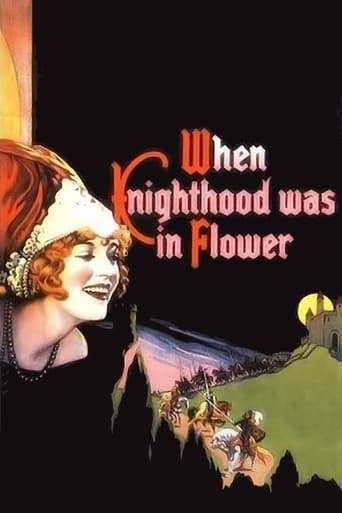
When Knighthood Was in Flower (1922)
Mary Tudor falls in love with a new arrival to court, Charles Brandon. She convinces her brother King Henry VIII to make him his Captain of the Guard. Meanwhile, Henry is determined to marry her off to the aging King Louis XII of France as part of a peace agreement.
- Erscheinungsdatum
- 1922-09-15
- TMDB
- 5.7 / 10 (13)
- Laufzeit
- 2 Std. 1 Min.
- Genres
- Drama, Liebesfilm
- Regie
- Robert G. Vignola
Besetzung
- Marion Davies — Mary Tudor
- Forrest Stanley — Charles Brandon
- Lyn Harding — Henry VIII
- Theresa Maxwell Conover — Queen Catherine
- Pedro de Cordoba — Duke of Buckingham
- Ruth Shepley — Lady Jane Bolingbroke
- Ernest Glendinning — Sir Edwin Caskoden
- Arthur Forrest — Cardinal Wolsey
- Johnny Dooley — Will Sommers
- William Kent — King's Tailor
- Charles K. Gerrard — Sir Adam Judson
- Arthur Donaldson — Sir Henry Brandon
Wissenswertes
- Basiert auf: Als das Rittertum in Blüte war
When Knighthood Was in Flower is a 1922 American silent historical film directed by Robert G. Vignola, based on the novel by Charles Major and play by Paul Kester. The film was produced by William Randolph Hearst for Marion Davies and distributed by Paramount Pictures. This was William Powell's second film. The story was re-filmed by Walt Disney in 1953 as The Sword and the Rose, directed by Ken Annakin.
Production
Exteriors were shot at Windsor Castle, England. With an estimated cost of $1,500,000, it was considered by Life "the most expensive film that has ever been produced" in 1922. According to Variety, William Randolph Hearst launched "the most expensive and extensive campaign that has ever been organized for anything theatrical", with over 650 billboards in New York, 300 subway advertising placards, special booths in department stores that sold souve…
Marion Davies makes her entrance coming down the river on a royal barge. The barge was a full-sized replica built in Bridgeport, Connecticut. The scene and the dance were filmed on the Laddins Rock Farm in Stamford/Old Greenwich, Connecticut. Hearst commissioned two songs from Victor Herbert: "The When Knighthood Was in Flower Waltz" and "The Marion Davies March," which were played at the New York premiere.
Auf Wikipedia weiterlesen · Text aus Wikipedia, CC BY-SA 4.0. Daten aus Wikidata.
Empfohlen
- Queen Kelly 1932 · ★ 6.5
- Mädchenlos 1920 · ★ 6.9
- Der Löwe im Winter 1968 · ★ 7.4
- Victoria, die junge Königin 2009 · ★ 7.2
- Selima & John 2003 · ★ 6.6
- Das Privatleben Heinrichs VIII. 1933 · ★ 6.4
- Richard III 1955 · ★ 7.2
- Die goldene Schale 2000 · ★ 6.0
- Königin Christine 1934 · ★ 6.9
- Maria von Schottland 1936 · ★ 6.2
- Der Scheich 1921 · ★ 5.9
- Romeo und Julia 1936 · ★ 6.2