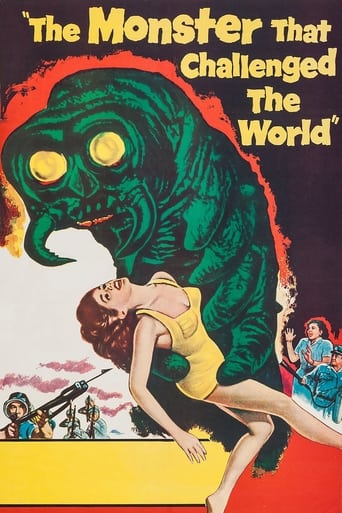
The Monster That Challenged the World (1957)
A new kind of terror to numb the nerves!
Giants Mollusks are released from the earth by an earthquake and start killing people.
- Date of release
- 1957-06-14
- TMDB
- 5.6 / 10 (58)
- Runtime
- 1h 24m
- Genres
- Horror, Science Fiction
- Director
- Arnold Laven
Casting
- Tim Holt — Lt. Cmdr. John 'Twill' Twillinger
- Audrey Dalton — Gail MacKenzie
- Hans Conried — Dr. Jess Rogers
- Barbara Darrow — Jody Simms
- Max Showalter — Dr. Tad Johns
- Harlan Warde — Lt. Robert 'Clem' Clemens
- Gordon Jones — Sheriff Josh Peters
- Mimi Gibson — Sandy MacKenzie
- Marjorie Stapp — Connie Blake
- Jody McCrea — Seaman Fred Johnson
- Wallace Earl — Sally
- Dennis McCarthy — George Blake (lab assistant)
Interesting facts
- Filmed in: California
The Monster That Challenged the World is a 1957 black-and-white science-fiction monster film from Gramercy Pictures, produced by Arthur Gardner, Jules V. Levy, and Arnold Laven, and starring Tim Holt and Audrey Dalton. The film was distributed by United Artists as the top half of a double feature with The Vampire. The film concerns an army of giant molluscs that emerge from California's Salton Sea.
Production
The story for The Monster That Challenged the World came from David Duncan, who also went on to pen screenplays for The Time Machine (1960) and Fantastic Voyage (1966). During production, Duncan's original work was titled The Jagged Edge, before the screenplay was renamed The Kraken. Prior to the film's release, it was once more retitled, this time to The Monster That Challenged the World.
Filming took place in 16 days on a budget of $200,000. A majority of the underwater scenes in the production were shot at Catalina Island off the coast of Los Angeles. Other primary filming locations included the Salton Sea, as well as Brawley and Barstow, California. The close-ups were later filmed in a tank filled with water and plastic seaweed.
In a 2016 interview, star Audrey Dalton recalled:
I thought it was a very interesting experience – as all my movies were in different ways. The director, Arnold Laven, had formed a production company with Jules Levy and Arthur Gardner. The monster stuff was fun, crouching behind a desk with a monster breaking down the wall. But you had to play it very straight. Once you start seeing the funny side of it, it doesn't work. Tim Holt had come out of retirement to do this movie.
Read on Wikipedia · Text from Wikipedia, CC BY-SA 4.0. Data from Wikidata.
Recommended
- Underwater 2020 · ★ 6.3
- The Last House 2026 · ★ 6.8
- Creature from the Black Lagoon 1954 · ★ 6.8
- The Meg 2018 · ★ 6.2
- 65 2023 · ★ 5.9
- Godzilla: King of the Monsters 2019 · ★ 6.7
- The Asphyx 1972 · ★ 6.0
- Tarantula 1955 · ★ 6.5
- It! The Terror from Beyond Space 1958 · ★ 5.8
- Battle: Los Angeles 2011 · ★ 5.8
- The Blob 1958 · ★ 6.2
- The End of Oak Street 2026 · ★ 7.0