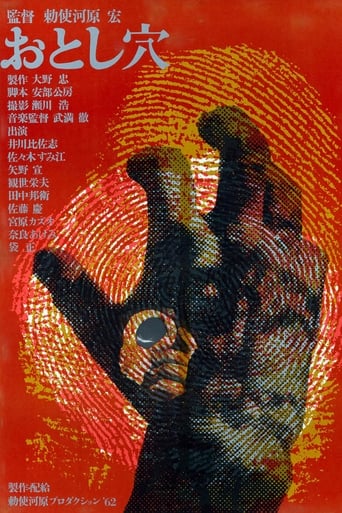
陷阱 (1962)
おとし穴
某山区矿工村,一个矿工突然被 “戴白手套的人”杀死。正巧矿上有个班长长得和死者十分相像,令矿工村的人吃惊。一天这个班长接到一个电话说工会要组织工人罢工。 班长赶往矿场途中,在沼泽地遇见了工会领导人。两人发生口角直至搏斗,都是因为那个电话。两人在沼泽地从正午一直滚打到夕阳下山。最后筋疲力尽,双方都莫名其妙地死去。与此同时,杂货店老板娘也被“戴白手套的人”杀死。这一件件奇怪的事凑巧都被一个偶然往来于这条路上的孩子看到,但他讲不清楚地到底看到了什么,因为他始终没有看到那个“戴白手套的人”的面孔,所以凶手到底是谁也弄不清楚,查不出来。 影片是一部长故事片,由导演勒使河原宏与日本当代文学家安部公房首次合作。安部公房的风格是用抽象的假定来剖析现实,勒使河原宏擅用记录风格。以这两种风格的结和构成了这部影片的独特风格。整个作品以镜头为第一个人称。对各种各样的日常事跟踪摄影,没有情节却有悬念,使影片从头至尾充满着一种奇妙的神秘气氛。本作品获1902年电影旬报十佳奖第七名。
演员阵容
- 井川比佐志 — Otsuka
- 佐佐木澄江 — Shopkeeper
- 矢野宣 — Toyama
- 观世荣夫 — Policeman
- 田中邦卫 — Man in White Suit
- 佐藤庆 — Reporter
- Kazuo Miyahara — Miner's Son
- 奈良あけみ — Wife
- 袋正 — Second Union Member
- 金内喜久夫 — Photographer
- Kanichi Ômiya — Second Miner
- Shigeru Matsuo — Farmer
趣闻
Pitfall , a.k.a. The Pitfall and Kashi To Kodomo, is a 1962 Japanese film directed by Hiroshi Teshigahara, written by Kōbō Abe. It was Teshigahara's first feature, and the first of his four film collaborations with Abe, the others being Woman in the Dunes, The Face of Another and The Man Without a Map. Unlike the others, which are based on novels by Abe, Pitfall was originally a television play called Purgatory (Rengoku). The film has been included in The Criterion Collection. It is known for its surreal storytelling structure and themes of hopelessness, exploitation, and human suffering.
Production
The film's focus on the exploitation of coal miners was likely influenced by Teshigahara and Abe's political leanings, and their sympathy with the Tokyo demonstrations in 1960 against Anpo.
The film was shot in Kyūshū, and incorporates stock footage of mining disasters and starvation that had afflicted the area. Many of the visual devices and themes are similar to the contemporaneous work of Shōhei Imamura, whose 1959 film My Second Brother also featured Kyūshū coal miners.
Teshigahara often disagreed with his film crew, and fired two assistant directors who did not wish to include the scene in which the policeman rapes the shopkeeper.
在维基百科阅读更多 · 文本来自维基百科,CC BY-SA 4.0。数据来自 Wikidata。