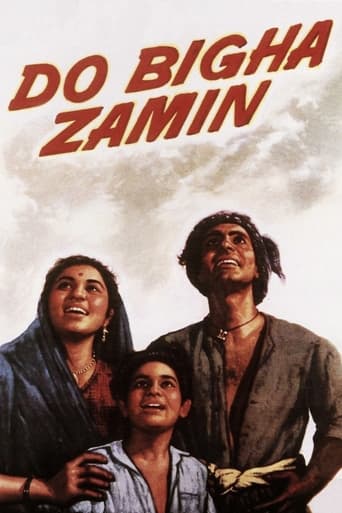
Two Acres of Land (1953)
दो बीघा ज़मीन
After falling for a cunning landlord’s scheme, a farmer (Balraj Sahni) and his young son (Ratan Kumar) travel to Calcutta in search of work to save money and reclaim their ancestral land.
Casting
- Balraj Sahni — Shambhu Maheto
- Nirupa Roy — Parvati Maheto
- Nana Palsikar — Dhangu Maheto
- Rattan Kumar — Kanhaiya Maheto
- Meena Kumari — Thakurain
- Mehmood — Preetam
- Murad — Thakur Harnam Singh
- Jagdeep — Laloo Ustad
- Hiralal
- Kusum
- Noor Jehan — Rani
- Misra
Interesting facts
- Box office: ₹7M
- Awards: 2 · Nominations: 0. Including: Filmfare Award for Best Film; Filmfare Award for Best Director
Do Bigha Zamin is a 1953 Indian Hindi-language drama film directed by Bimal Roy. Based on Rabindranath Tagore's Bengali poem "Dui Bigha Jomi" and Rickshawalla, a short story written by composer Salil Chowdhury, the film stars Balraj Sahni and Nirupa Roy in lead roles. Known for its socialist theme, Do Bigha Zamin is considered an important film in the early parallel cinema of India, and a trend setter.
Production
In 1952, at the first International Film Festival in Mumbai, director Bimal Roy saw Vittorio De Sica's 1948 Italian film Bicycle Thieves (1954). In the train while he was returning home, he decided to make his next film as real as the film and shot on location. His wife, Manobina Roy, recalled her excited husband instructing his unit to come up with a story right after the screening.
Initially Roy had planned to cast Paidi Jairaj, Trilok Kapoor and Nazir Hussain in the lead, then he saw the performance of Balraj Sahni in Hum Log (1951) and decided to cast him. This decision of Roy was criticised by his team as Sahni had mostly done rich roles. To better prepare for the role, Balraj Sahni actually rehearsed for the role by pulling a rickshaw on the streets of Calcutta.
The films title is derived from a famous poem by Rabindranath Tagore, called "Dui Bigha Jomi". Bimal Roy distributed the film abroad with the name "Calcutta – The Cruel City". The measurement of Bigha varies from state to state. In Bengal, where the movie is based, 3 bigha is one acre (4,000 m2). Roy filmed Parineeta (1953) and Do Bigha Zamin at the same time in Kolkata. Hrishikesh Mukherjee was the film's editor and scenario writer.
Read on Wikipedia · Text from Wikipedia, CC BY-SA 4.0. Data from Wikidata.
Recommended
- Hurry Sundown 1967 · ★ 6.4
- Homebound 2025 · ★ 7.7
- Fast Girls 2012 · ★ 6.0
- The Truth About Emanuel 2013 · ★ 6.0
- The Color of Friendship 2000 · ★ 6.7
- Little Lord Fauntleroy 1980 · ★ 7.3
- Eleanor the Great 2025 · ★ 6.8
- The Keys of the Kingdom 1944 · ★ 7.1
- Return 2011 · ★ 6.4
- The River 1984 · ★ 6.4
- Raajneeti 2010 · ★ 6.3
- Where the Red Fern Grows 1974 · ★ 6.9