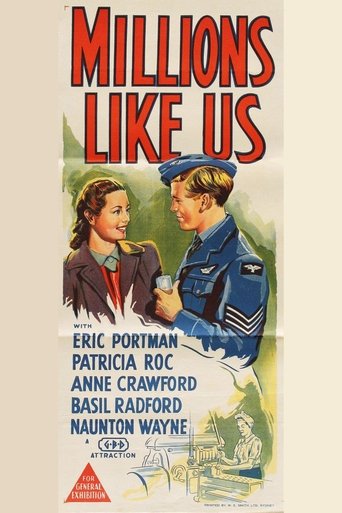
Millions Like Us (1943)
When Celia Crowson is called up for war service, she hopes for a glamorous job in one of the services, but as a single girl, she is directed into a factory making aircraft parts. Here she meets other girls from all different walks of life and begins a relationship with a young airman.
- Erscheinungsdatum
- 1943-06-01
- TMDB
- 5.6 / 10 (15)
- Laufzeit
- 1 Std. 43 Min.
- Genres
- Drama, Kriegsfilm, Liebesfilm
- Regie
- Sidney Gilliat, Frank Launder
Besetzung
- Patricia Roc — Celia Crowson
- Gordon Jackson — Fred Blake
- Anne Crawford — Jennifer Knowles
- Moore Marriott — Jim Crowson
- Basil Radford — Charters
- Megs Jenkins — Gwen Price
- Eric Portman — Charlie Forbes
- Joy Shelton — Phyllis Crowson
- Naunton Wayne — Caldicott
- Terry Randall — Annie
- Amy Veness — Mrs. Blythe
- Brenda Bruce — Brenda
Wissenswertes
Millions Like Us is a 1943 British propaganda film co-written and co-directed by Sidney Gilliat and Frank Launder and starring Patricia Roc, Gordon Jackson, Anne Crawford, Basil Radford, Naunton Wayne, Moore Marriott and Eric Portman. The film shows life in a wartime aircraft factory in documentary detail. According to the British Film Institute database, this film is the first in an "unofficial trilogy", along with Two Thousand Women (1944) and Waterloo Road (1945).
Production
The film was originally intended as a documentary for the Ministry of Information but then their film division suggested it be done as a fictional movie and the project was produced at Gainsborough Studios. Screenwriters Frank Launder and Sidney Gilliat decided to share direction, both recording their debuts in that capacity. They afterwards felt that having two directors had often confused the actors.
Roger Burford had suggested to the producers that they create a film covering the entire British war effort on the Home Front. The directors decided the task was too big and that the subject needed a fictional story to tie the material together. They focused on women working in an aircraft factory to show the effect of the war on ordinary people from a variety of backgrounds. The directors originally wanted to call the film The Mobile Woman.
Anne Crawford was brought in to replace Sheila Bell, a lovely girl with a sad story. Eric Portman didn't want to play in the film and went to Halifax and got drunk, but was threatened by Ted Black and ended by being co-operative with us. It was very demanding, being both writers and directors on the film, and the Ostrers thought the whole project ludicrous. Ted Black didn't get on with Maurice and Bill Ostrer, who wanted to take creative credit.
Factory scenes were filmed at Castle Bromwich Aircraft Factory, with employees serving as extras.
Beethoven's Fifth Symphony is used liberally in the soundtrack. Gilliat says "we were not responsible for the terrible assault of Beethoven.
Auf Wikipedia weiterlesen · Text aus Wikipedia, CC BY-SA 4.0. Daten aus Wikidata.
Empfohlen
- Firebird 2021 · ★ 7.4
- Zeit zu leben und Zeit zu sterben 1958 · ★ 7.2
- Die Geschichte der Liebe 2016 · ★ 6.5
- Das Narrenschiff 1965 · ★ 6.7
- Maria's Lovers 1984 · ★ 6.0
- Private Peaceful - Mein Bruder Charlie 2012 · ★ 6.6
- North & South - Die Schlacht bei New Market 2015 · ★ 6.1
- Waterloo Bridge 1931 · ★ 6.9
- Samstagnacht bis Sonntagmorgen 1960 · ★ 7.0
- Kesselschlacht 1949 · ★ 6.7
- Purple Hearts 2022 · ★ 8.0
- Ashes in the Snow 2018 · ★ 6.3