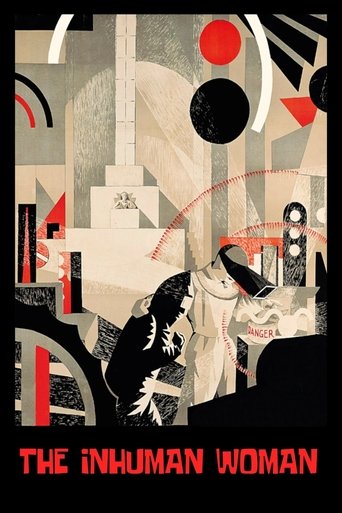
The Inhuman Woman (1924)
L'Inhumaine
A famous singer Claire Lescot, who lives on the outskirts of Paris, is courted by many men, including a maharajah, Djorah de Nopur, and a young Swedish scientist, Einar Norsen. At her lavish parties she enjoys their amorous attentions but she remains emotionally aloof and heartlessly taunts them. When she is told that Norsen has killed himself because of her, she shows no feelings. At her next concert she is booed by an audience outraged at her coldness and she decides to visit the vault in which Norsen's body lies.
- Date of release
- 1924-12-12
- TMDB
- 6.9 / 10 (35)
- Runtime
- 2h 3m
- Genres
- Drama, Science Fiction
- Director
- Marcel L'Herbier
Casting
- Georgette Leblanc — Claire Lescot
- Jaque Catelain — Einar Norsen
- Léonid Walter de Malte — Wladimir Kranine
- Fred Kellerman — Frank Mahler
- Philippe Hériat — Djorah de Nopur
- Marcelle Pradot — The simpleton
- Kiki of Montparnasse
- Lili Samuel
Interesting facts
L'Inhumaine is a 1924 French science fiction drama film directed by Marcel L'Herbier. It has the subtitle histoire féerique. L'Inhumaine is notable for its experimental techniques and for the collaboration of many leading practitioners in the decorative arts, architecture and music. The film caused controversy on its release.
Production
Filming began in September 1923 at the Joinville studios in Paris and had to be carried on at great speed because Georgette Leblanc was committed to return to America in mid-October for a concert tour. L'Herbier often continued shooting through the night, making intense demands on his cast and crew. In the event, Leblanc had to leave before everything was finished and some scenes could only be completed when she returned to Paris in spring 1924.
One evening of location shooting became famous (4 October 1923). For the scene of Claire Lescot's concert L'Herbier hired the Théâtre des Champs-Élysées and invited over 2000 people from the film world and fashionable society to attend in evening dress and to play the part of an unruly audience. Ten cameras were deployed around the theatre to record their reactions to the concert.
A wide range of practitioners in different fields of the arts worked on the film, meeting L'Herbier's ambition of creating a film which united many forms of artistic expression. Four designers contributed to the sets. The painter Fernand Léger created the mechanical laboratory of Einar Norsen. The architect Robert Mallet-Stevens designed the exteriors of the houses of Norsen and Claire Lescot, with strong cubist elements.
The final sequence of the film, in which Claire is 'resurrected', is an elaborate exercise in rapid cutting, whose expressive possibilities had recently been demonstrated in La Roue. In addition to the juxtaposition and rhythmic repetition of images, L'Herbier interspersed frames of bright colours, intending to create counterpoint to the music of Milhaud and "to make the light sing".
Read on Wikipedia · Text from Wikipedia, CC BY-SA 4.0. Data from Wikidata.
Recommended
- Jonathan 2018 · ★ 5.9
- Vesper 2022 · ★ 6.2
- The Congress 2013 · ★ 6.4
- 24 Days 2014 · ★ 6.6
- The Mandela Effect 2019 · ★ 6.3
- SAS: Red Notice 2021 · ★ 5.8
- Doctor Who: Last Christmas 2014 · ★ 7.7
- Hello 2022 · ★ 6.3
- Kompromat 2022 · ★ 6.3
- The Man Who Fell to Earth 1976 · ★ 6.5
- Rogue Agent 2022 · ★ 6.3
- 2073 2024 · ★ 6.7