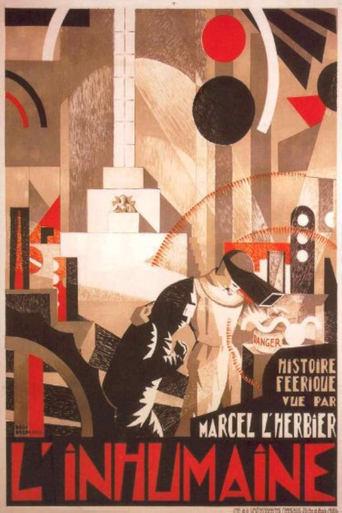
Бесчеловечность (1924)
L'Inhumaine
Клэр Лескот — знаменитая примадонна. Все мужчины хотят быть любимыми ею. Среди них и молодой ученый Эйнар Норсен. Когда она высмеивает его, он покидает ее дом со страшным намерением…
- Дата выхода
- 1924-12-12
- TMDB
- 6.8 / 10 (36)
- Длительность
- 2 ч 15 мин
- Жанры
- драма, фантастика
- Режиссёр
- Marcel L'Herbier
В ролях
- Georgette Leblanc — Claire Lescot
- Jaque Catelain — Einar Norsen
- Léonid Walter de Malte — Wladimir Kranine
- Fred Kellerman — Frank Mahler
- Philippe Hériat — Djorah de Nopur
- Marcelle Pradot — The simpleton
- Kiki of Montparnasse
- Lili Samuel
Интересные факты
L'Inhumaine is a 1924 French science fiction drama film directed by Marcel L'Herbier. It has the subtitle histoire féerique. L'Inhumaine is notable for its experimental techniques and for the collaboration of many leading practitioners in the decorative arts, architecture and music. The film caused controversy on its release.
Production
Filming began in September 1923 at the Joinville studios in Paris and had to be carried on at great speed because Georgette Leblanc was committed to return to America in mid-October for a concert tour. L'Herbier often continued shooting through the night, making intense demands on his cast and crew. In the event, Leblanc had to leave before everything was finished and some scenes could only be completed when she returned to Paris in spring 1924.
One evening of location shooting became famous (4 October 1923). For the scene of Claire Lescot's concert L'Herbier hired the Théâtre des Champs-Élysées and invited over 2000 people from the film world and fashionable society to attend in evening dress and to play the part of an unruly audience. Ten cameras were deployed around the theatre to record their reactions to the concert.
A wide range of practitioners in different fields of the arts worked on the film, meeting L'Herbier's ambition of creating a film which united many forms of artistic expression. Four designers contributed to the sets. The painter Fernand Léger created the mechanical laboratory of Einar Norsen. The architect Robert Mallet-Stevens designed the exteriors of the houses of Norsen and Claire Lescot, with strong cubist elements.
The final sequence of the film, in which Claire is 'resurrected', is an elaborate exercise in rapid cutting, whose expressive possibilities had recently been demonstrated in La Roue. In addition to the juxtaposition and rhythmic repetition of images, L'Herbier interspersed frames of bright colours, intending to create counterpoint to the music of Milhaud and "to make the light sing".
Читать в Википедии · Текст из Википедии, CC BY-SA 4.0. Данные Викиданных.
Рекомендуем
- Дубликат 2018 · ★ 5.9
- Эра выживания 2022 · ★ 6.2
- Конгресс 2013 · ★ 6.4
- Цена риска 1983 · ★ 6.5
- Кадр 2014 · ★ 6.3
- Эффект Манделы 2019 · ★ 6.3
- Аэлита 1924 · ★ 5.9
- 2073 2024 · ★ 6.7
- Мира 2022 · ★ 7.5
- Доктор Кто: Последнее рождество 2014 · ★ 7.7
- Петля времени 2024 · ★ 6.0
- Создания 1966 · ★ 6.5