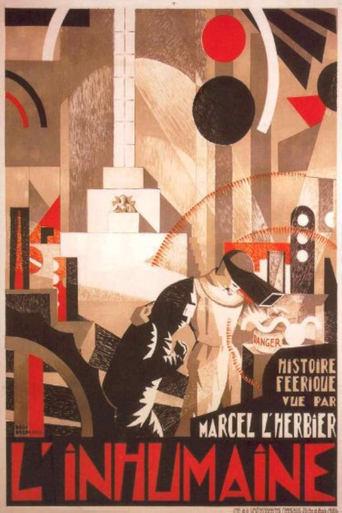
无情的女人 (1924)
L'Inhumaine
住在巴黎郊区的著名歌手克莱尔·莱斯考特受到许多男人的追求,其中包括王公德乔拉·德·诺普尔和年轻的瑞典科学家埃纳尔·诺森。 在她奢华的聚会上,她享受他们的多情关注,但她在情感上仍然冷漠并无情地嘲笑他们。 当她被告知诺森因为她而自杀时,她没有表现出任何感情。 在她的下一场音乐会上,观众对她的冷漠感到愤怒,向她发出嘘声。 她参观了诺森尸体所在的金库,当她承认自己对他的感情时,她发现他还活着。 他的死是假死的。 乔拉嫉妒他们的新关系,导致克莱尔被毒蛇咬伤。 她的尸体被带到诺森的实验室,在那里他利用他的科学发明使克莱尔复活。
- 上映日期
- 1924-12-12
- TMDB
- 6.8 / 10 (36)
- 片长(分钟)
- 2小时3分钟
- 类型
- 剧情, 科幻
- 导演
- Marcel L'Herbier
演员阵容
- Georgette Leblanc — Claire Lescot
- Jaque Catelain — Einar Norsen
- Léonid Walter de Malte — Wladimir Kranine
- Fred Kellerman — Frank Mahler
- Philippe Hériat — Djorah de Nopur
- Marcelle Pradot — The simpleton
- Kiki of Montparnasse
- Lili Samuel
趣闻
L'Inhumaine is a 1924 French science fiction drama film directed by Marcel L'Herbier. It has the subtitle histoire féerique. L'Inhumaine is notable for its experimental techniques and for the collaboration of many leading practitioners in the decorative arts, architecture and music. The film caused controversy on its release.
Production
Filming began in September 1923 at the Joinville studios in Paris and had to be carried on at great speed because Georgette Leblanc was committed to return to America in mid-October for a concert tour. L'Herbier often continued shooting through the night, making intense demands on his cast and crew. In the event, Leblanc had to leave before everything was finished and some scenes could only be completed when she returned to Paris in spring 1924.
One evening of location shooting became famous (4 October 1923). For the scene of Claire Lescot's concert L'Herbier hired the Théâtre des Champs-Élysées and invited over 2000 people from the film world and fashionable society to attend in evening dress and to play the part of an unruly audience. Ten cameras were deployed around the theatre to record their reactions to the concert.
A wide range of practitioners in different fields of the arts worked on the film, meeting L'Herbier's ambition of creating a film which united many forms of artistic expression. Four designers contributed to the sets. The painter Fernand Léger created the mechanical laboratory of Einar Norsen. The architect Robert Mallet-Stevens designed the exteriors of the houses of Norsen and Claire Lescot, with strong cubist elements.
The final sequence of the film, in which Claire is 'resurrected', is an elaborate exercise in rapid cutting, whose expressive possibilities had recently been demonstrated in La Roue. In addition to the juxtaposition and rhythmic repetition of images, L'Herbier interspersed frames of bright colours, intending to create counterpoint to the music of Milhaud and "to make the light sing".
在维基百科阅读更多 · 文本来自维基百科,CC BY-SA 4.0。数据来自 Wikidata。