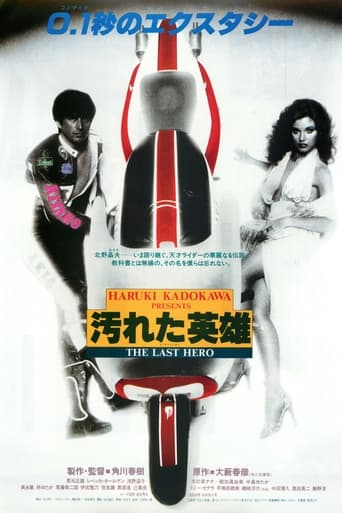
汚れた英雄 (1982)
The 8th All-Japan Road Race Championship. The internationally ranked A-level SUGO circuit is on the edge of its seat as the 500 cc final draws near. Akio Kitano and Keishi Ooki face off: private team versus factory team. In the final lap, Akio is overtaken by Ooki and loses by a hair. The reason for his defeat? The difference between their two machines. With their scores tied, the two wait for the next match to settle the score for good.
Cast
- 草刈正雄 — Akio Kitano
- Rebecca Holden — Christine Adams
- 木の実ナナ — Keiko Saitou
- 浅野温子 — Azusa Ogata
- 奥田瑛二 — Muneyuki Ogata
- 磯崎洋介 — Kazumi Ogata
- 勝野洋 — Keishi Ooki
- 林ゆたか — Takashi Amemiya
- 朝加真由美 — Naoko Mikimoto
- 草薙幸二郎 — Tetsuya Kamedani
- 中田博久 — Hatada
- 清水昭博 — Shimazaki
Curiosità
The Last Hero , also known as Dirty Hero, is a 1982 Japanese motorcycle racing drama film directed by Haruki Kadokawa. It was adapted by Shōichi Maruyama from Haruhiko Oyabu's novel Dirty Hero. The Last Hero was Kadokawa's directorial debut. The film tells the story of Akio Kitano, a motorcycle road racer who attempts to win the All Japan Road Race Championship while simultaneously wooing an American woman. It stars Masao Kusakari in the lead role, in addition to Rebecca Holden, Nana Kinomi, Atsuko Asano and Eiji Okuda. Yuichiro Oda and Masato Kai co-composed the film's score, while the songs "Riding High", "The Last Hero" and "The Lonely Rider" were performed by Rosemary Butler.
Production
By the late 1970s, Kadokawa Shoten owned film adaptation rights to the novel, while Tokuma Shoten owned the publishing rights. A deal was struck between the companies; Kadokawa would receive publishing rights, while Tokuma optioned the adaptation rights for three years. Tokuma Shoten's owner at the time, Yasuyoshi Tokuma, asked producer Yoshinobu Nishizaki to kickstart production. Tokuma and Nishizaki's companies would split the production cost.
After the Kadokawa-produced film Sailor Suit and Machine Gun was a box office hit in December 1981, Toei Company president Shigeru Okada asked Kadokawa to produce another film for the 1982 holiday season. It was decided that this would be The Last Hero.
Kadokawa did not originally plan to direct The Last Hero. Seijun Suzuki, Kichitaro Negishi and Tōru Murakawa were approached to direct, but they all turned down the offer. Eventually, Kadokawa decided to make the film himself.
The original novel is set in the 1950s. This was changed to a contemporary setting for the film. Screenwriter Maruyama stated that the film's runtime was a limitation in the adaptation process. He ultimately chose to depict Akio's character arc accurately, rather than stay true to the plot itself.
Filming lasted for 70 days, from August to early October 1982. The film's opening sequence was shot at Sportsland Sugo, while the climactic race was shot at the Suzuka Circuit. Hideo Kanaya served as the production's racing supervisor.
Leggi su Wikipedia · Testo da Wikipedia, CC BY-SA 4.0. Dati da Wikidata.
Consigliati
- New Initial D the Movie - Legend 2: Racer 2015 · ★ 7.9
- New Initial D the Movie - Legend 3: Dream 2016 · ★ 7.5
- Born to Race 2011 · ★ 7.0
- The Fast and the Furious: Tokyo Drift 2006 · ★ 6.6
- Beast 2026 · ★ 7.5
- Need for Speed 2014 · ★ 6.5
- Never Back Down 3 - Mai arrendersi 2016 · ★ 7.0
- Fast & Furious 7 2015 · ★ 7.2
- Violence 1967 · ★ 6.4
- La corsa più pazza d'America 1981 · ★ 6.2
- Supercross 2005 · ★ 6.3
- Born to Race: Fast Track 2014 · ★ 6.5