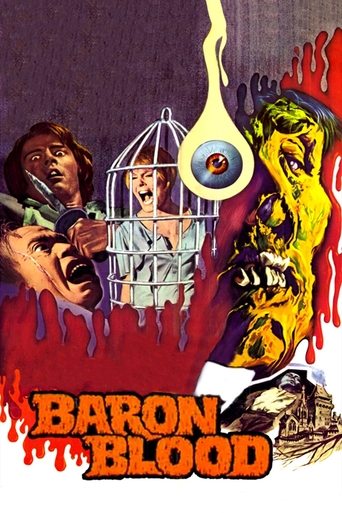
Baron Blood (1972)
Gli orrori del castello di Norimberga
He sought the ultimate in HUMAN AGONY... with instruments of TORTURE ghastly beyond belief!
A young man, Peter, returns to Austria in search of his heritage. There he visits the castle of an ancestor, a sadistic Baron who was cursed to a violent death by a witch whom the Baron had burned at the stake. Peter reads aloud the incantation that causes Baron Blood to return and continue his murderous tortures.
- Date of release
- 1972-02-25
- TMDB
- 6.1 / 10 (153)
- Runtime
- 1h 38m
- Genres
- Horror
- Director
- Mario Bava
Casting
- Joseph Cotten — Baron Otto von Kleist / Alfred Becker
- Elke Sommer — Eva Arnold
- Massimo Girotti — Dr. Karl Hummel
- Antonio Cantafora — Peter Kleist
- Umberto Raho — Inspector
- Luciano Pigozzi — Fritz
- Nicoletta Elmi — Gretchen Hummel
- Dieter Tressler — Mayor Dortmundt
- Rolf Halwich — Auctioner
- Gustavo De Nardo — Dr. Werner Hesse
- Valeria Sabel — Martha Hummel
- Rada Rassimov — Christina Hoffmann
Interesting facts
Baron Blood is a 1972 horror film directed by Mario Bava, and starring Joseph Cotten, Elke Sommer, Massimo Girotti, Antonio Cantafora and Rada Rassimov. The film centers on Baron Otto von Kleist (Cotten), a murderous noble who is resurrected from the dead by his descendant, Peter (Cantafora), and a college student named Eva (Sommer).
Production
Baron Blood originated as a screenplay written by Vincent G. Fotre, a professional tennis player who dabbled in writing movies. The screenplay was acquired by independent producer Jerry Briskin, who showed it to Alfredo Leone in hopes he would be interested in co-producing it.
The writing credits given onscreen vary in different versions of the film. Italian prints credit the screenplay to "Wilibald Eser" and Bava. English-language releases credit the story and screenplay solely to Fotre, "adapted for the screen by" another American writer, William A. Bairn.
Baron Blood marked Bava's return to gothic horror, six years after Kill, Baby... Kill!. Leone handled the casting, though Nicoletta Elmi, who had appeared in Bava's earlier film A Bay of Blood, was cast at Bava's request. Both Vincent Price and Ray Milland were approached to play the titular role, before Joseph Cotten was cast.
The film began shooting in 1971, which included location work at the Austrian castle Burg Kreuzenstein. According to Leone, Bava was so excited by the castle's filming possibilities that when Leone told him he had secured the deal to use the castle, Bava embraced and kissed him. Other scenes were shot in the town of Klosterneuburg, and at a studio in Rome.
The film's credited cinematographer is Antonio Rinaldi, although Leone stated that Bava took over cinematography for the film, with Rinaldi handling the second unit shots. To satisfy a pre-acquisition agreement with distributor Allied Artists, most of the film's violent scenes were filmed twice, one for theatrical release and one for television, with the violence being toned down in the latter version.
Read on Wikipedia · Text from Wikipedia, CC BY-SA 4.0. Data from Wikidata.
Recommended
- Blood on Satan's Claw 1971 · ★ 6.2
- Ghostland 2018 · ★ 7.4
- House of 1000 Corpses 2003 · ★ 6.2
- Two Witches 2023 · ★ 6.0
- The Night Evelyn Came Out of the Grave 1971 · ★ 6.0
- Nosferatu 2024 · ★ 6.7
- The Boogeyman 2023 · ★ 6.4
- The Entity 1982 · ★ 6.9
- Inferno 1980 · ★ 6.6
- The Exorcist III 1990 · ★ 6.3
- Death Game 1977 · ★ 5.9
- The Evil 1978 · ★ 5.8