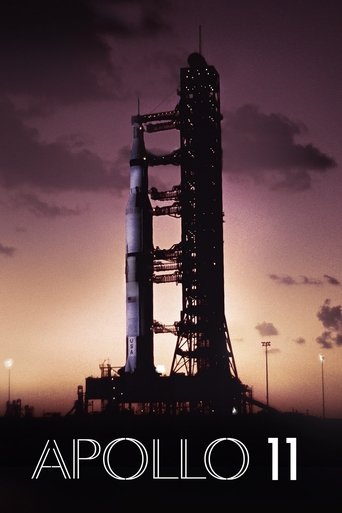
Apollo 11 (2019)
A Cinematic Event 50 Years In The Making
A look at the Apollo 11 mission to land on the moon led by commander Neil Armstrong and pilot Buzz Aldrin.
- Date of release
- 2019-03-01
- TMDB
- 7.9 / 10 (747)
- Runtime
- 1h 33m
- Genres
- Documentary, History, Drama
- Director
- Todd Douglas Miller
Casting
- Neil Armstrong — Self (archive footage)
- Buzz Aldrin — Self (archive footage)
- Michael Collins — Self (archive footage)
- Walter Cronkite — Self (archive footage)
- Bruce McCandless II — Self (archive footage)
- Charlie Duke — Self (archive footage)
- Andy Aldrin — Self
- Patricia Mary Finnegan — Self
- Janet Armstrong — Self
- John F. Kennedy — Self (archive footage)
- Jim Lovell — Self
- Gene Kranz — Self - Flight Director White Team
Interesting facts
- Awards: 1 · Nominations: 0. Including: Sundance Special Jury Prize Documentary
Apollo 11 is a 2019 American documentary film edited, produced, and directed by Todd Douglas Miller. It focuses on the 1969 Apollo 11 mission, the first spaceflight to land humans on the Moon. The film consists solely of archival footage, including 70 mm film previously unreleased to the public, and does not feature narration, interviews, or modern recreations. The Saturn V rocket, Apollo 11 crew, and Apollo program Earth-based mission operations engineers are prominently featured in the film.
Production
In late 2016, Todd Douglas Miller had recently completed work on The Last Steps, a documentary short about Apollo 17, when British archival producer and film editor Stephen Slater suggested making a similarly themed documentary for the upcoming 50th anniversary of Apollo 11. CNN Films subsequently became a partner in the project.
Miller's conception of the film was centered on a direct cinema approach. The final film contains no voice-over narration or interviews beyond what was available in the contemporary source material. Portions of the mission are illustrated by animated graphics depicting the parts of the Apollo spacecraft as line drawings, the designs of which are based on the cel-animated graphics in Theo Kamecke's 1971 documentary Moonwalk One.
In May 2017, cooperation between Miller's production team, NASA, and the National Archives and Records Administration resulted in the discovery of unreleased 70 mm footage from the preparation, launch, mission control operations, recovery, and post flight activities of Apollo 11.
The filmmakers used the facilities of Final Frame, a post-production firm in New York City, to make high-resolution digital scans of all reels depicting ground based activities that were available in the National Archives. Specialized climate-controlled vans were used to safely transport the archival material to and from College Park, Maryland.
In addition to hundreds of hours of video, the production team sourced over 11,000 hours of audio recordings. Among the audio recordings were 30-track tapes of voice recordings at every Mission Control station. Ben Feist, a Canadian software engineer, wrote software to improve the fidelity of the newly available audio.
Read on Wikipedia · Text from Wikipedia, CC BY-SA 4.0. Data from Wikidata.
Recommended
- Apollo: Missions to the Moon 2019 · ★ 7.3
- In the Shadow of the Moon 2007 · ★ 7.6
- Apollo 13: Survival 2024 · ★ 7.2
- Alone in the Wilderness 2004 · ★ 7.9
- Supersonic 2016 · ★ 7.4
- The Endurance 2000 · ★ 6.9
- I Called Him Morgan 2016 · ★ 7.0
- 9/11: Inside the President's War Room 2021 · ★ 6.8
- Audrey 2020 · ★ 7.0
- Titanic: 20 Years Later with James Cameron 2017 · ★ 6.6
- My Generation 2017 · ★ 7.0
- All That Breathes 2022 · ★ 6.9