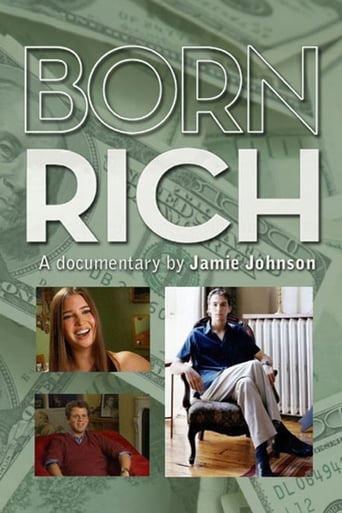
Born Rich (2003)
A documentary on children of the insanely rich. Directed by one of their own, Johnson & Johnson heir, Jamie Johnson.
- Date of release
- 2003-01-19
- TMDB
- 6.6 / 10 (30)
- Runtime
- 1h 15m
- Genres
- Documentary
- Director
- Jamie Johnson
Casting
- Ivanka Trump — Self
- Georgina Bloomberg — Self
- Christina Floyd — Self
- Juliet Hartford — Self
- Si Newhouse IV — Self
- Luke Weil — Self
- Cody Franchetti — Self
- Josiah Hornblower — Self
- Carlo von Zeitschel — Self
- Peter L. Skolnik — Self
Interesting facts
Born Rich is a 2003 documentary film about the experience of growing up in wealthy families. It was created by Jamie Johnson, an heir to the Johnson & Johnson fortune, and filmed primarily between 1999 and 2001. The film consists primarily of Johnson interviewing 10 other young heirs. These interviews are offset by Johnson's exploration of his own experience and family as he comes into a large inheritance on his 21st birthday. He seeks out how to be a productive person, avoiding the dysfunction that he sees affecting many of the very rich. The film explores the taboo the ultra rich have against talking about their wealth.
Production
Made over a three-year period while he was a history student at NYU, the documentary started out as his graduation thesis. At the age of 20, Johnson came up with the idea for the film through conversations with his uncle, Dirk Wittenborn, a novelist and screenwriter, who is also a producer of the film. Having been brought up reading F.
It took three years to make as most of the young heirs contacted to participate in the film turned him down, sometimes harshly, due to parental objection, fear of losing their inheritance, or fear of violating social taboo. A Campbell's soup heir and a Rockefeller initially agreed to participate but both of them backed out due to a parent's objections.
By summer of 2000, after a year of filming, most of those interviewed were asking Johnson to take them out of the movie. Carlo von Zeitschel threatened a lawsuit but never filed. Johnson recalls people approaching him at parties telling him that he was a traitor to his class, that making the documentary was the "stupidest thing" he could do, it would not benefit anyone, and he would regret it and lose all his friends.
The editing process took over a year, with 45 hours of footage to edit. While the film was being edited, Wittenborn wrote an article about the film that appeared in the September 2002 issue of W magazine. After hearing early reports about the film, Luke Weil filed a lawsuit on September 4, 2002, demanding that his scenes be removed. The lawsuit was featured in the film.
Weil alleged in the lawsuit that he had been "tricked" into participating in what he thought would solely be a school project. Wittenborn recalls that when he was questioned by Weil during the filming, he told Weil about his work in film and television, and that they hoped to sell the film to HBO.
Read on Wikipedia · Text from Wikipedia, CC BY-SA 4.0. Data from Wikidata.
Recommended
- Capital in the Twenty-First Century 2019 · ★ 6.5
- Above Majestic 2018 · ★ 7.4
- I Am Heath Ledger 2017 · ★ 7.4
- 180° South 2010 · ★ 7.2
- Heart of a Dog 2015 · ★ 6.5
- The Captains 2011 · ★ 6.4
- The Crystal Calls - Making The Dark Crystal: Age of Resistance 2019 · ★ 7.5
- Elstree 1976 2015 · ★ 6.2
- Being James Bond 2021 · ★ 7.8
- Samsara 2011 · ★ 8.1
- The Secret 2006 · ★ 6.6
- Cameraperson 2016 · ★ 6.7