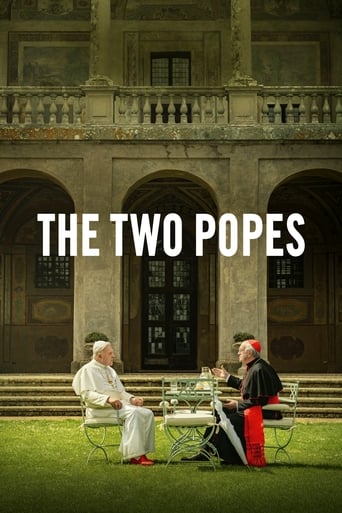
The Two Popes (2019)
Inspired by true events.
Frustrated with the direction of the church, Cardinal Bergoglio requests permission to retire in 2012 from Pope Benedict. Instead, facing scandal and self-doubt, the introspective Pope Benedict summons his harshest critic and future successor to Rome to reveal a secret that would shake the foundations of the Catholic Church.
- Date of release
- 2019-11-27
- TMDB
- 7.5 / 10 (3263)
- Runtime
- 2h 5m
- Genres
- Drama, History
- Director
- Fernando Meirelles
Casting
- Jonathan Pryce — Jorge Bergoglio / Pope Francis
- Anthony Hopkins — Joseph Ratzinger / Pope Benedict XVI
- Juan Minujín — Young Jorge Bergoglio
- Luis Gnecco — Cardinal Hummes
- Cristina Banegas — Lisabetta
- María Ucedo — Esther Ballestrine
- Renato Scarpa — Camerlengo
- Sidney Cole — Cardinal Turkson
- Achille Brugnini — Cardinal Martini
- Federico Torre — Protodeacon Estevez
- Germán de Silva — Father Yorio
- Lisandro Fiks — Father Jalics
Interesting facts
The Two Popes is a 2019 biographical drama film directed by Fernando Meirelles and written by Anthony McCarten, adapted from McCarten's play The Pope which premiered at Royal & Derngate Theatre in 2019. Predominantly set in Vatican City in the aftermath of the Vatican leaks scandal, the film follows Pope Benedict XVI, played by Anthony Hopkins, as he attempts to convince Cardinal Jorge Mario Bergoglio, played by Jonathan Pryce, to reconsider his decision to resign as an archbishop as he confides his own intentions to abdicate the papacy.
Production
On September 6, 2017, Netflix announced that it would produce the film, directed by Fernando Meirelles and written by Anthony McCarten. Jonathan Pryce and Anthony Hopkins would play Cardinal Bergoglio and Pope Benedict XVI, respectively. Filming was set to begin that November in Argentina. The film began production in Rome in April 2018.
Filming locations included a refugee camp in Rome, a full-size reproduction of the Sistine Chapel interior created at the Cinecittà studios in Rome, an area outside Castel Gandolfo (the pope's summer palace), various locations in Rome as stand-ins for scenes at the Vatican, and poor areas of Buenos Aires. The St. Peter's Square plaza was recreated using computer-generated imagery.
Much of the coverage of the film in the news media has centered on the reconstructed Sistine Chapel, built in a studio during an eight-week period. To create a realistic look for the artwork, the producers hired a company that produced a "stick-on tattoo" of the walls and ceiling. "The ink from the tattoo is absorbed into the plaster so [...] we got all the texture and the vibrancy", said production designer Mark Tildesley.
Read on Wikipedia · Text from Wikipedia, CC BY-SA 4.0. Data from Wikidata.
Recommended
- Spotlight 2015 · ★ 7.8
- Shattered Glass 2003 · ★ 7.0
- The Scarlet and the Black 1983 · ★ 7.1
- Romero 1989 · ★ 6.9
- Munich - The Edge of War 2021 · ★ 6.9
- Intolerance: Love's Struggle Throughout the Ages 1916 · ★ 7.1
- Richard Jewell 2019 · ★ 7.4
- The Boy in the Woods 2023 · ★ 7.0
- Paul, Apostle of Christ 2018 · ★ 7.6
- Doubt 2008 · ★ 7.2
- Unbroken: Path to Redemption 2018 · ★ 6.7
- Giant 2026 · ★ 6.7