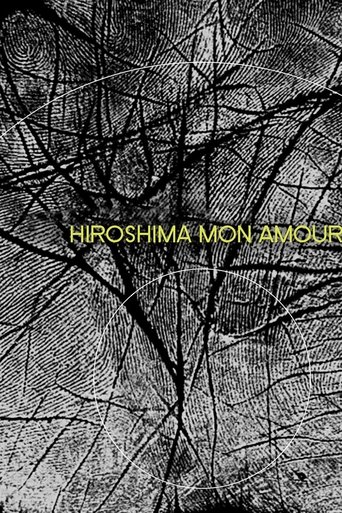
Hiroshima Mon Amour (1959)
Hiroshima mon amour
From the measureless depths of a woman's emotions...
The deep conversation between a Japanese architect and a French actress forms the basis of this celebrated French film, considered one of the vanguard productions of the French New Wave. Set in Hiroshima after the end of World War II, the couple -- lovers turned friends -- recount, over many hours, previous romances and life experiences. The two intertwine their stories about the past with pondering the devastation wrought by the atomic bomb dropped on the city.
- Date of release
- 1959-06-10
- TMDB
- 7.7 / 10 (973)
- Runtime
- 1h 32m
- Genres
- Drama, History, Romance
- Director
- Alain Resnais
Casting
- Emmanuelle Riva — Elle
- Eiji Okada — Lui
- Stella Dassas — Mother
- Pierre Barbaud — Father
- Bernard Fresson — German Lover
Interesting facts
- Awards: 0 · Nominations: 1
Hiroshima mon amour is a 1959 romantic drama film directed by French director Alain Resnais and written by French author Marguerite Duras.
Production
In 1954, while Alain Resnais was editing Agnès Varda's film La Pointe Courte, he was reluctant to work on it because it was "so nearly the film he wanted to make himself". The film's narrative structure inspired Hiroshima mon amour.
According to James Monaco, Resnais was originally commissioned to make a short documentary about the atomic bomb, but spent several months confused about how to proceed because he did not want to recreate his 1956 Holocaust documentary Night and Fog. He later went to his producer and joked that the film could not be done unless Marguerite Duras was involved in writing the screenplay.
Explaining how she and Resnais sought to find something original to say about Hiroshima, about which much had by then already been said, Duras wrote in 1958: "[W]e tried to bring Hiroshima back as a love story ... We tried to make it so that between two people as geographically, philosophically, historically, economically, racially, etc.
The film was a co-production by companies from both France and Japan. The producers stipulated that one main character must be French and the other Japanese, and also required that the film be shot in both countries employing film crews comprising technicians from each. The French scenes were shot in Nevers. However, several scenes from the film located in Nevers were, in fact, filmed in Autun.
Among the film's innovations is the way Resnais intercut very brief flashback sequences into scenes to suggest a brief flash of memory. He later used a similar effect in Last Year at Marienbad (1961) and The War Is Over (1966).
Read on Wikipedia · Text from Wikipedia, CC BY-SA 4.0. Data from Wikidata.
Recommended
- The Apartment 1996 · ★ 6.8
- Paris Je T'aime 2006 · ★ 6.8
- Indochine 1992 · ★ 7.0
- Head in the Clouds 2004 · ★ 5.9
- Wings 1927 · ★ 7.2
- Goodbye First Love 2011 · ★ 6.3
- Cyrano 2021 · ★ 6.3
- Promise at Dawn 2017 · ★ 7.2
- Sayonara 1957 · ★ 6.7
- Wild Reeds 1994 · ★ 7.0
- The Last Letter from Your Lover 2021 · ★ 7.3
- Cyrano de Bergerac 1950 · ★ 6.9