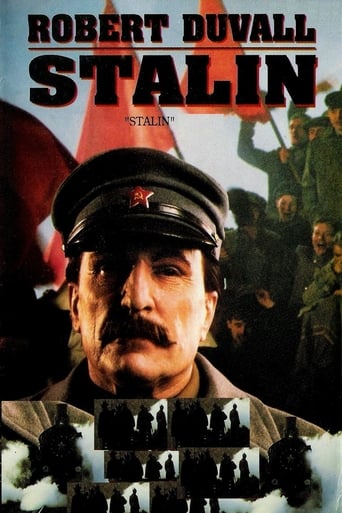
Stalin (1992)
The life and career of the brutal Soviet dictator, Josef Stalin. Through the eyes and memories of Anna Aliluyeva, Stalin’s granddaughter, the film traces the rise of the Bolshevik tyrant from Lenin’s return from exile to his brutal struggle with Trotsky, the creation of his feared secret police and the merciless inner workings of his regime. As Anna recounts her grandfather’s life, viewers gain an intimate, personal perspective on the paranoia and purges that left even his closest circles living in constant fear.
- Date of release
- 1992-11-21
- TMDB
- 5.3 / 10 (39)
- Runtime
- 2h 52m
- Genres
- Drama, History, War, TV Movie
- Director
- Ivan Passer
Casting
- Robert Duvall — Josef Stalin
- Julia Ormond — Nadya Alliluyeva
- Maximilian Schell — Vladimir Lenin
- Jeroen Krabbé — Bukharin
- Joan Plowright — Olga
- Jim Carter — Sergo
- Miriam Margolyes — Krupskaya
- Frank Finlay — Sergei
- Roshan Seth — Beria
- Daniel Massey — Trotsky
- András Bálint — Zinoviev
- John Bowe — Voroshilov
Interesting facts
- Filmed in: Moscow, Budapest, and Kremlin
- Awards: 2 · Nominations: 2. Including: Primetime Emmy Award for Outstanding Television Movie; Primetime Emmy Award for Outstanding Cinematography for a Miniseries or Movie
Stalin is a 1992 American political drama television film starring Robert Duvall as Soviet leader Joseph Stalin. Produced by HBO Pictures and directed by Ivan Passer, it tells the story of Stalin's rise to power until his death and spans the period from 1917 to 1953. Owing to Soviet leader Mikhail Gorbachev's policies of glasnost and perestroika, producer Mark Carliner was able to receive permission to film in the Kremlin, becoming the first feature film to do so. The film premiered on HBO on November 21, 1992.
Filming
Filming began in October 1991 and was shot exclusively in the Soviet Union at several original locations, including in Stalin's Kuntsevo Dacha, prisons, the Kyiv railway station and for the first time ever, the Kremlin. During the filming in the Russian White House, the film crew worked while Mikhail Gorbachev engaged in government affairs one floor below.
Friends of Carliner, who had filmed in Russia before, warned him about difficult and sometimes unusual challenges. Several minor problems occurred during the estimated seven-week shooting period. Extras went on strike to demand higher pay. Engine drivers were already drunk by 8 a.m., so they couldn't keep their signals.
There was a power outage at Stalin's dacha just after the final death scene was filmed. Sometimes, a whole day of shooting was lost because extras weren't there. Stalin's victory speech in the Kremlin hall originally involved a meal. The shooting schedule was set at eight in the morning, but the extras were missing because they were still ten kilometers away at the make-up area.
Duvall, who lived the whole time in Savoy Hotel, had to spend more than four hours a day being "transformed" into Stalin by two make-up specialists. However, the procedure was reduced to around 75 minutes during the course of filming. Overall, the film was shot in nine six-day weeks. On December 21, 1991, four hours after the Soviet Union had dissolved with the signing of the Alma-Ata Protocol, the final scene was shot at Stalin's dacha.
To test the effect of their masks, Schell and Duvall went out among the people in their respective personas as Lenin and Stalin. Schell was often ignored while Duvall experienced rejection and contempt.
Read on Wikipedia · Text from Wikipedia, CC BY-SA 4.0. Data from Wikidata.
Recommended
- Bonhoeffer: Pastor. Spy. Assassin 2024 · ★ 6.7
- The Courier 2020 · ★ 7.0
- The Scarlet and the Black 1983 · ★ 7.1
- Uprising 2001 · ★ 6.6
- The Boy in the Woods 2023 · ★ 7.0
- The Great Escape 1963 · ★ 7.9
- Six Minutes to Midnight 2020 · ★ 6.2
- The Way Back 2010 · ★ 7.0
- The Zone of Interest 2023 · ★ 7.0
- K-19: The Widowmaker 2002 · ★ 6.6
- Hope and Glory 1987 · ★ 6.9
- A Call to Spy 2020 · ★ 6.8