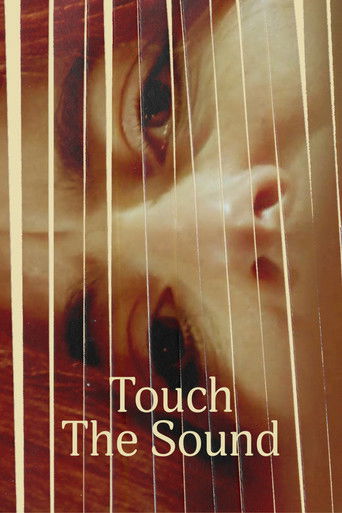
Touch the Sound (2004)
A Sound Journey with Evelyn Glennie
A documentary which explores the connections among sound, rhythm, time, and the body by following percussionist Evelyn Glennie, who is nearly deaf.
- Date of release
- 2004-09-10
- TMDB
- 7.4 / 10 (14)
- Runtime
- 1h 39m
- Genres
- Documentary, Music
- Director
- Thomas Riedelsheimer
Casting
- Evelyn Glennie — Herself
- Fred Frith — Himself
Interesting facts
- Awards: 0 · Nominations: 1
Touch the Sound: A Sound Journey with Evelyn Glennie is a 2004 German documentary film directed by Thomas Riedelsheimer about profoundly deaf Scottish classical percussionist Evelyn Glennie. In the film Glennie, who won a Grammy Award in 1989, collaborates with English experimental musician Fred Frith and others, and explains how she perceives sound. The film appeared at over 20 film festivals across the world, and won several awards, including "Best Documentary" at the 2004 BAFTA Awards, Scotland.
Background
German filmmaker Thomas Riedelsheimer's previous film Rivers and Tides (2001) received several awards, including Best Documentary awards by the German Film Critics Association, the San Diego Film Critics Society and the San Francisco Film Critics Circle. The soundtrack of the film was composed and performed by English experimental musician Fred Frith.
In 2003 Riedelsheimer asked Frith to perform with Scottish percussionist Evelyn Glennie in Touch the Sound. The venue was an abandoned sugar factory in Dormagen, Germany, and their performance was filmed under the pretext of "making a record". Frith and Glennie had never worked together before and their entire performance was improvised.
In addition to appearing on the soundtrack of Touch the Sound, music from Frith and Glennie's performance in the sugar factory was later reworked and released by the pair on a CD in 2007 entitled The Sugar Factory.
Riedelsheimer explained why he chose to create a film about Glennie: "I was so struck by her. What was amazing was not so much the music itself but the way she is in it. That finally became the subject – not music, but sound and the ability to feel the sounds around us." He said that the "biggest challenge" of the project was to "transfer acoustics or sound ideas into images" and "to find images that are metaphors for these sounds".
Read on Wikipedia · Text from Wikipedia, CC BY-SA 4.0. Data from Wikidata.
Recommended
- Selena Gomez: My Mind & Me 2022 · ★ 8.4
- The Beach Boys 2024 · ★ 6.7
- Rolling Thunder Revue: A Bob Dylan Story by Martin Scorsese 2019 · ★ 7.0
- Biggie: I Got a Story to Tell 2021 · ★ 7.1
- Travis Scott: Look Mom I Can Fly 2019 · ★ 6.8
- Something from Nothing: The Art of Rap 2012 · ★ 6.7
- Halftime 2022 · ★ 6.8
- Shawn Mendes: In Wonder 2020 · ★ 8.1
- Lewis Capaldi: How I'm Feeling Now 2023 · ★ 7.5
- The Sound of 007 2022 · ★ 7.3
- The Velvet Underground 2021 · ★ 6.8
- Zappa 2020 · ★ 7.2