Honeyland (2019)
Медена земја
If one breaks the rule, everyone pays the price.
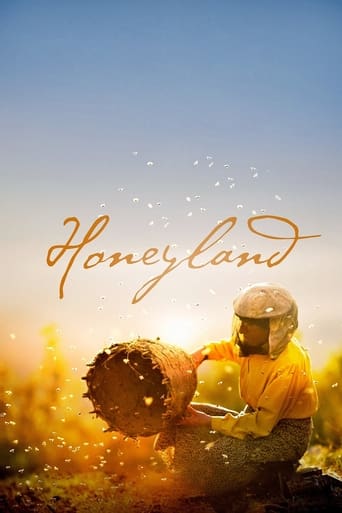
When nomadic beekeepers break Honeyland’s basic rule (take half of the honey, but leave half to the bees), the last female beehunter in Europe must save the bees and restore natural balance.
- Date of release
- 2019-07-26
- TMDB
- 7.9 / 10 (315)
- Runtime
- 1h 29m
- Genres
- Documentary
- Director
- Ljubomir Stefanov, Tamara Kotevska
Casting
- Hatidzhe Muratova — Self
- Nazife Muratova — Self
- Hussein Sam — Self
- Ljutvie Sam — Self
Interesting facts
- Awards: 2 · Nominations: 2. Including: Sundance Film Festival World Cinema Grand Jury Prize: Documentary; Sundance World Cinema Special Jury Prize Documentary
Honeyland is a 2019 Macedonian documentary film that was directed by Tamara Kotevska and Ljubomir Stefanov. It portrays the life of Hatidže Muratova, a lonely beekeeper of wild bees who lives in the remote mountain village of Bekirlija and follows her lifestyle before and after neighbors move in nearby. The film was initially planned as a short film documenting the region surrounding the river Bregalnica but its area of focus changed when the directors met Hatidže. Honeyland received its world premiere at the 2019 Sundance Film Festival on 28 January and it has grossed $1,315,037.
Filming and production
Starting in 2015, the documentary was filmed over three years and the final version was condensed from more than 400 hours of footage. Due to the remoteness of Bekirlija, the production team stayed there for three-to-four consecutive days before going to nearby towns for supplies and to recharge their filming equipment. They slept in tents and hammocks in front of Hatidže's house.
The documentary uses fly on the wall style; it does not use any voice-overs and subjects filmed do not look directly at the camera, which gives it an "invisible" quality. According to Kotevska and Stefanov, during filming they mainly relied on visual observations of their subjects, whose language they did not understand.
The film's score was composed and performed by the Macedonian band Foltin under the musical supervision of Rana Eid from the production company DB Studios in Beirut, Lebanon. The directors decided to collaborate with Foltin on the movie's score because they deemed Foltin original and capable of creating music specifically tailored for the documentary.
After the film, the filmmakers bought Hatidže a house close to her brother's family, although she still spends bee season in her old village. They also set up a donation page supporting Sams' children on the film's website.
Read on Wikipedia · Text from Wikipedia, CC BY-SA 4.0. Data from Wikidata.
Recommended
- The Biggest Little Farm 2019 · ★ 7.6
- A Gorilla Story: Told by David Attenborough 2026 · ★ 8.0
- Cow 2022 · ★ 6.4
- Baraka 1992 · ★ 8.2
- The Elephant Queen 2019 · ★ 7.3
- The Class of ‘92 2013 · ★ 7.1
- Powaqqatsi 1988 · ★ 7.2
- Dolphin Reef 2018 · ★ 6.8
- That Sugar Film 2014 · ★ 6.9
- Dancing with the Birds 2019 · ★ 7.8
- Elephant 2020 · ★ 7.7
- Burma VJ: Reporting from a Closed Country 2008 · ★ 7.3