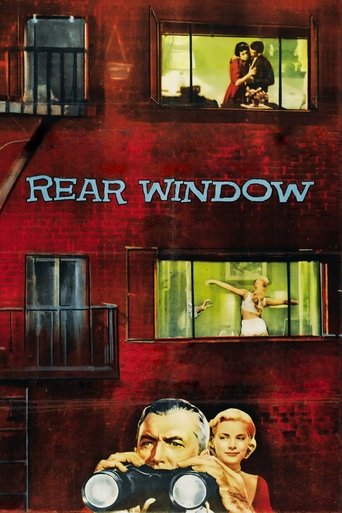
Rear Window (1954)
It only takes one witness to spoil the perfect crime.
A wheelchair-bound photographer spies on his neighbors from his apartment window and becomes convinced one of them has committed murder.
- Date of release
- 1954-08-01
- TMDB
- 8.3 / 10 (7530)
- Runtime
- 1h 53m
- Genres
- Thriller, Mystery, Drama
- Director
- Alfred Hitchcock
Casting
- James Stewart — L.B. Jefferies
- Grace Kelly — Lisa Fremont
- Wendell Corey — Thomas Doyle
- Thelma Ritter — Stella
- Raymond Burr — Lars Thorwald
- Judith Evelyn — Miss Lonelyhearts
- Ross Bagdasarian — Songwriter
- Georgine Darcy — Miss Torso
- Sara Berner — Woman on Fire Escape
- Frank Cady — Man on Fire Escape
- Jesslyn Fax — Miss Hearing Aid
- Rand Harper — Newlywed
Interesting facts
- Box office: $37M
- Budget: $1M
- Earned 37× its budget
- Awards: 0 · Nominations: 4
Rear Window is a 1954 American mystery thriller film produced and directed by Alfred Hitchcock and written by John Michael Hayes, based on Cornell Woolrich's 1942 short story "It Had to Be Murder". Originally released by Paramount Pictures, the film stars James Stewart, Grace Kelly, Wendell Corey, Thelma Ritter, and Raymond Burr. It was screened at the 1954 Venice Film Festival in competition for the Golden Lion.
Production
The screenplay, which was written by John Michael Hayes, was based on Cornell Woolrich's 1942 short story It Had to Be Murder. Hitchcock hired Hayes in 1953 to turn Woolrich's short story into a screenplay. Hayes made several changes to the original story, including making Jeff a traveling photographer. This helped explain how Jeff broke his leg and gave more background to his character.
Hayes developed Lisa's character with Grace Kelly in mind, using parts of her personality and his wife's career as inspiration. Hitchcock and Hayes continued making changes to the screenplay before filming began. One of these changes involved removing an earlier subplot about an unfaithful husband and changing the story involving the couple whose dog was killed.
Before filming began, Hitchcock worked through the screenplay with Hayes to plan how each scene would be filmed. Hitchcock drew sketches showing the camera angles and put them together into storyboards. The camera crew and editors used these drawings to help plan their work. The storyboards were also updated during filming when changes were made.
However, in 1990 the question as to who owned the film rights of Woolrich's original story went before the Supreme Court of the United States in Stewart v. Abend. Although the film was copyrighted in 1954 by Patron Inc., a production company set up by Hitchcock and Stewart, a subsequent rights holder refused to acknowledge previous rights agreements. As a result, Stewart and Hitchcock's estate became involved in the Supreme Court case.
Most of the film was shot on Stage 18 at Paramount Studios which included an enormous indoor set to replicate a Greenwich Village courtyard, with the set stretching from the bottom of the basement storeroom to the top of the lighting grid in the ceiling. The lighting was rigged with four interchangeable scene lighting arrangements: morning, afternoon, evening, and night-time.
Read on Wikipedia · Text from Wikipedia, CC BY-SA 4.0. Data from Wikidata.
Recommended
- Aurora Teagarden Mysteries: A Very Foul Play 2019 · ★ 7.5
- Witness for the Prosecution 1957 · ★ 8.2
- Out of Time 2003 · ★ 6.4
- Ten Little Indians 1965 · ★ 6.3
- Conspiracy Theory 1997 · ★ 6.6
- Remember 2015 · ★ 7.4
- Killer's Kiss 1955 · ★ 6.3
- The Caveman's Valentine 2001 · ★ 5.9
- The Gift 2015 · ★ 6.7
- Footsteps in the Fog 1955 · ★ 7.0
- The Stranger 2022 · ★ 6.2
- A Double Life 1947 · ★ 6.4