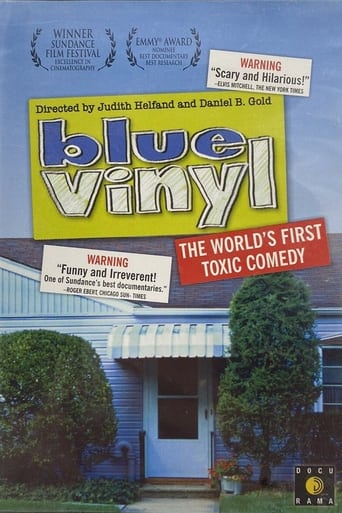
Blue Vinyl (2002)
With humor, chutzpah and a piece of vinyl siding firmly in hand, Peabody Award-winning filmmaker Judith Helfand and co-director and award-winning cinematographer Daniel B. Gold set out in search of the truth about polyvinyl chloride (PVC), America's most popular plastic. From Long Island to Louisiana to Italy, they unearth the facts about PVC and its effects on human health and the environment.
- Data di uscita
- 2002-01-10
- TMDB
- 6.0 / 10 (7)
- Durata
- 1 h 33 min
- Generi
- Documentario
- Regista
- Judith Helfand, Daniel B. Gold
Cast
- Judith Helfand — Self
- Florence Helfand — Self
- Ted Helfand — Self
- Billy Baggett — Self - Lawyer
Curiosità
Blue Vinyl is a 2002 documentary film directed by Daniel B. Gold and Judith Helfand. With a lighthearted tone, the film follows one woman's quest for an environmentally sound cladding for her parents' house in Merrick, Long Island, New York. It also investigates the many negative health effects of polyvinyl chloride in its production, use and disposal, focusing on the communities of Lake Charles and Mossville, Louisiana, and Venice, Italy. Filming for Blue Vinyl began in 1994. It was aired on HBO as part of the series America Undercover.
Background
PVC or polyvinyl chloride production dates back to the 19th century but began being widely used in the 1950s when companies discovered its versatility. By the 1980s, 20 companies were producing PVC. The advancements in chemical makeup made the material ideal for construction.
Hefland investigates these newer concerns with the production of PVC and tries to determine whether companies like the vinyl institute were committed to protecting their consumers with these types of guidelines.
Blue Vinyl teamed up with Working Films to create the My House is Your House Campaign to turn the film into an organizing tool by increasing deliberate consumer advocacy and influencing industry change.
The My House is Your House campaign sparked out of this documentary to continue the efforts after an attempt to inspire consumers through the film. This campaign focuses on the harmful effects of Polyvinyl Chloride production also known as "PVC" or "Vinyl." 75% of all PVC is used in construction materials. According to this campaign, PVC plastic is considered one of the most detrimental in terms of harmful effects.
In addition to the health risks associated with PVC production, environmentalists associated with the film suggest that dioxins released through PVC plants do not disappear but are absorbed by animals and humans. PVC is also non-recyclable and highly flammable causing complications with the life cycle of this construction product.
Leggi su Wikipedia · Testo da Wikipedia, CC BY-SA 4.0. Dati da Wikidata.
Consigliati
- Alla corte di Ruth 2018 · ★ 7.5
- Born in China 2019 · ★ 7.2
- The Cutting Edge: The Magic of Movie Editing 2004 · ★ 7.0
- I Am Ali 2014 · ★ 6.7
- Anna Nicole Smith: La vera storia 2023 · ★ 6.1
- Cuore di un cane 2015 · ★ 6.5
- Feminists: Ritratti di un'epoca 2018 · ★ 7.5
- Cameraperson 2016 · ★ 6.7
- Making 'The Shining' 1980 · ★ 7.1
- Visions of Light 1992 · ★ 7.0
- S4 - La storia di Bob Lazar 2026 · ★ 8.4
- My Beautiful Broken Brain 2014 · ★ 7.0