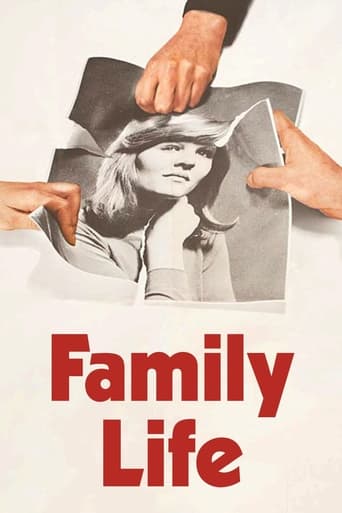
Family Life (1971)
Janice Baildon ist ein 19-jähriges Mädchen, das mitten in einer Identitätskrise steckt. Als sie schwanger wird, zwingen ihre konservativen Eltern sie zur Abtreibung, woraufhin sie einen Nervenzusammenbruch erleidet. Anstatt Verständnis für ihre Tochter aufzubringen und sie in ihrer schwierigen Lebenslage zu unterstützen, weisen die Eltern Janice in eine psychiatrische Klinik ein. Es folgt eine grausame Elektroschockbehandlung, bis nichts weiter von ihr übrig bleibt, als die leblose Hülle eines Menschen.
Besetzung
- Sandy Ratcliff — Janice Baildon
- Bill Dean — Mr. Baildon
- Grace Cave — Mrs. Baildon
- Michael Riddall — Dr. Donaldson
- Malcolm Tierney — Tim
- Hilary Martin — Barbara Baildon
- Alan MacNaughtan — Dr. Caswell
- Johnny Gee — Man in Garden
- Bernard Atha
- Edwin Brown
- Freddie Clemson
- Alec Coleman
Wissenswertes
Family Life is a 1971 British drama film directed by Ken Loach and starring Sandy Ratcliff, Malcolm Tierney and Grace Cave. The screenplay was by David Mercer. It is a remake of In Two Minds, an episode of the BBC's Wednesday Play series first transmitted by the BBC in March 1967, which was also written by Mercer and directed by Loach.
Production
Tony Garnett became interested in the work of psychiatrist R. D. Laing as a member of his family suffered from mental illness. He arranged for David Mercer to write a screenplay. It resulted in the play Two Minds which Garnett said was inspired by the story of Julie, a case in Laing's 1960 book The Divided Self. "I regretted later it might be seen as scapegoating the mother," wrote Garnett.
The production was a success but Garnett said the fate and experience of his family member with the psychiatric profession "kept nagging away at me" so he decided to turn it into a film. Mercer was reluctant as "he rightly felt he had done the subject" but he was eventually persuaded. Garnett says Loach "didn't see the point but was easier to persuade. Directors always want to work in cinema."
"It's the only subject where I've insisted we had two bites at the cherry, for my own personal reasons," said Garnett. "It was so important to me, to do with a woman in my life and a painful time. Although it wasn't necessarily a sensible thing to do, it was almost an obsession in me to try to understand what had gone on."
Garnett claimed Mercer's "screenplay was barely adequate. It was lazy, perhaps because his heart wasn't in it. I wanted to do more work on it with him. He was reluctant. I probably should have called it a day then. With David on strike, but naturally reluctant to allow me to rewrite it, we had an insecure basis for a film.
Half the budget was provided by the National Film Finance Corporation, who had financed the script; the other half came from Nat Cohen and Anglo-EMI, who had previously financed successful films from Ken Loach (Poor Cow) and Garnett (The Body). Garnett wrote in his memoirs that when he pitched the project to Cohen, the executive summarised the story as "So, a mad girl goes into a mental hospital and goes madder. An unhappy ending.
Auf Wikipedia weiterlesen · Text aus Wikipedia, CC BY-SA 4.0. Daten aus Wikidata.
Empfohlen
- Neverwas 2005 · ★ 6.4
- State of Mind - Der Kampf des Dr. Stone 2017 · ★ 6.7
- Ein Engel an meiner Tafel 1990 · ★ 7.0
- Urchin 2025 · ★ 6.8
- Streets of New York 1993 · ★ 6.6
- Bronson 2009 · ★ 6.9
- Land of the Blind 2006 · ★ 5.8
- Einer flog über das Kuckucksnest 1975 · ★ 8.4
- Die Agentin 2019 · ★ 5.8
- Jimmy P. – Psychotherapie eines Indianers 2013 · ★ 6.1
- Linda's Child 2013 · ★ 6.0
- First Snow 2006 · ★ 6.1