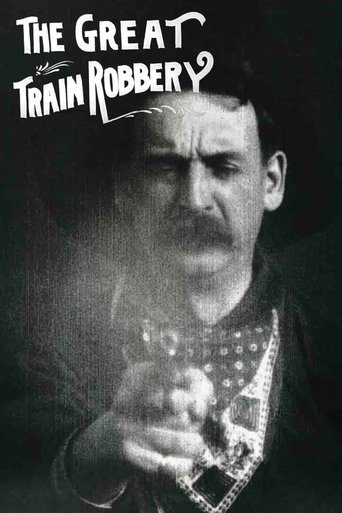
The Great Train Robbery (1903)
It electrified dad! It terrified mother! It will amuse you!
After the train station clerk is assaulted and left bound and gagged, then the departing train and its passengers robbed, a posse goes in hot pursuit of the fleeing bandits.
- Date of release
- 1903-12-07
- TMDB
- 7.0 / 10 (733)
- Runtime
- 12m
- Genres
- Western, Crime, Action, Adventure
- Director
- Edwin S. Porter
Casting
- Gilbert M. Anderson — Bandit / Shot Passenger / Tenderfoot Dancer (uncredited)
- John Manus Dougherty Sr. — Bandit (uncredited)
- Frank Hanaway — Bandit (uncredited)
- Adam Charles Hayman — Bandit (uncredited)
- Robert Milasch — Trainman / Bandit (uncredited)
- Marie Murray — Dance-Hall Dancer (uncredited)
- Mary Snow — Little Girl (uncredited)
- A.C. Abadie — Sheriff (uncredited)
- Walter Cameron — Sheriff (uncredited)
- Donald Gallaher — Little Boy (uncredited)
- Shadrack E. Graham — Child (uncredited)
- George Barnes — (uncredited)
Interesting facts
- Budget: $250
- Filmed in: New Jersey
The Great Train Robbery is a 1903 American silent Western action film made by Edwin S. Porter for the Edison Manufacturing Company. It follows a gang of outlaws who hold up and rob a steam train at a station in the American West, flee across mountainous terrain, and are finally defeated by a posse of locals. The short film draws on many sources, including a robust existing tradition of Western films, recent European innovations in film technique, the play of the same name by Scott Marble, the popularity of train-themed films, and possibly real-life incidents involving outlaws such as Butch Cassidy.
Production
In the years leading up to The Great Train Robbery, the film industry was marked by much innovation and variety. Some studios, such as the Edison Manufacturing Company and the Lumière company, were best known for short sketches and actuality films presented in a straightforward style, often only a single shot long.
Edwin S. Porter had won acclaim making cameras, film printers, and projectors; however, after his workshop was destroyed by a fire, he accepted a special commission for the Edison Manufacturing Company in 1901. His task to improve Edison's existing projecting equipment was a marked success, and Porter was given a regular job as the cameraman for Edison's New York film studio; at the time being a cameraman meant operating the camera as well as exe…
The Edison studio, facing growing competition from other American companies, welcomed Porter's ambitious plans. His first major attempts at elaborate storytelling films included a 1902 adaptation of Jack and the Beanstalk in imitation of Méliès, and a 1903 Life of an American Fireman in the style of a notable Brighton School film, Fire! His films did well and were influential, bolstered by his status as the leading filmmaker at the most important…
Porter (and possibly Anderson) drew on various sources when planning the scenario for The Great Train Robbery. Western themes were already popular in films and other entertainment, reflecting the wide public interest in stories about the past and present of the American West.
For the film's title and basic concept, Porter looked to Scott Marble's The Great Train Robbery, a popular stage melodrama that had premiered in Chicago in 1896 and had been revived in New York in 1902. The play covers the adventures of a Texas criminal gang who attempt to steal a $50,000 gold shipment from a Wells Fargo office in Missouri.
Read on Wikipedia · Text from Wikipedia, CC BY-SA 4.0. Data from Wikidata.
Recommended
- Bandidas 2006 · ★ 6.1
- Boss Nigger 1975 · ★ 6.7
- Barbarosa 1982 · ★ 5.9
- Colorado Territory 1949 · ★ 7.0
- How to Rob a Bank 2007 · ★ 5.8
- Blue Streak 1999 · ★ 6.5
- The War Wagon 1967 · ★ 6.8
- Gunless 2010 · ★ 6.4
- American Outlaws 2001 · ★ 5.9
- Silver Streak 1976 · ★ 6.7
- Doc West 2009 · ★ 6.2
- Stark Raving Mad 2002 · ★ 6.1