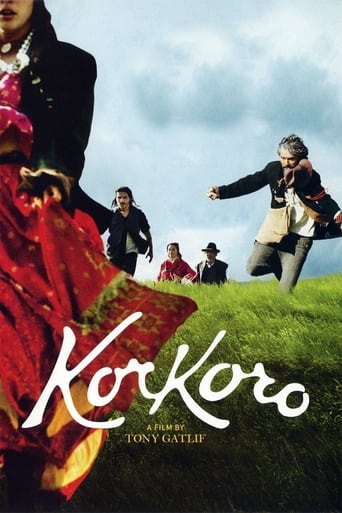
Freedom (2009)
Korkoro
A Gypsy family travels the French roads during the Second World War, followed by Little Claude, a young boy seeking a new family after his parents "left and never returned". Upon reaching a town where they traditionally stop for a few months and work in vineyards, they learn that a new law forbids them from being nomadic. Theodore, the town's mayor, and Miss Lundi, the schoolteacher, protect and help the Gypsies. Despite this, They are arrested and placed in an internment camp. Theodore manages to rescue them and gives them a piece of property where they must settle. But the Gypsies' deeply ingrained thirst for freedom makes this sedentary lifestyle difficult to bear. After Theodore and Miss Lundi are arrested for resistance, the Gypsies decide they must get back on the move in order to remain free.
- Date of release
- 2009-08-01
- TMDB
- 6.5 / 10 (33)
- Runtime
- 1h 51m
- Genres
- Drama
- Director
- Tony Gatlif
Casting
- Marc Lavoine — Théodore
- James Thierrée — Taloche
- Mathias Laliberté — P'tit Claude
- Marie-Josée Croze — Miss Lundi
- Carlo Brandt — Pierre Pentecôte
- Rufus — Fernand
- Arben Bajraktaraj — Darko
- Giorgi Babluani — Kako
- Ilir Selmoski — Chavo
- Kevyn Diana — Zanko
- Bojana Panic — Tina
- Jean-Pierre Laurent — Léon Radet
Interesting facts
- Filmed in: Loire
- Awards: 1 · Nominations: 0. Including: Montreal World Film Festival
Korkoro is a 2009 French drama film written and directed by Tony Gatlif, starring Francophone actors Marc Lavoine, Marie-Josée Croze and James Thiérrée. The film's cast were of many nationalities such as Albanian, Kosovar, Georgian, Serbian, French, Norwegian, and nine Romani people Gatlif recruited in Transylvania.
Production
During World War II, the Porajmos was the attempt by Nazi Germany, the Independent State of Croatia, Horthy's Hungary and their allies to exterminate the Romani people of Europe. Under Hitler’s rule, both Romani and Jews were defined as "enemies of the race-based state" by the Nuremberg Laws; the two groups were targeted by similar policies and persecution, culminating in the near annihilation of both populations in Nazi-occupied countries.
Because Eastern European Romani communities were less organised than Jewish communities, Porajmos was not well documented. There also existed a trend to downplay the actual figures, according to Ian Hancock, director of the Program of Romani Studies at the University of Texas at Austin.
Gatlif's quest began in 1970 when he approached Matéo Maximoff, a French writer of Romani ethnicity. The two went to Montreuil to interview the Romani who were initially not very forthcoming discussing the subject of Porajmos. Gatlif was also researching the Justes, the French who attempted to shield the Romani from persecution.
The characters in Korkoro are drawn from Sigot's anecdote. The film traces the Romani familia's life during the war, from their disbelief at being forbidden to travel, their rejection by others when they stay in one place, to their arrest, incarceration, liberation with the help of a local French mayor and a notary, their struggle to live in a non-nomadic way, and then final arrest before being sent to the Death Camps.
Intended to be a documentary, Korkoro became a drama because of the lack of sufficient supporting documents. Gatlif wrote the initial script in one month; further modifications later followed which made the film's style a narrative by the characters Rosier and Lundi. Gatlif used Lundy's help to write the scenes related to her, to which he added his own experiences with his teacher.
Read on Wikipedia · Text from Wikipedia, CC BY-SA 4.0. Data from Wikidata.
Recommended
- The Minister 2011 · ★ 6.4
- Adieu Philippine 1962 · ★ 6.8
- The Young One 1960 · ★ 7.0
- The Passengers of the Night 2022 · ★ 6.9
- Skin 2009 · ★ 6.4
- Chaos 2001 · ★ 6.4
- Night of the Kings 2021 · ★ 6.6
- Brother 2019 · ★ 6.5
- Élisa 1995 · ★ 6.4
- Declaration of War 2011 · ★ 7.0
- Michou d'Auber 2007 · ★ 6.4
- The Divide 2021 · ★ 6.6