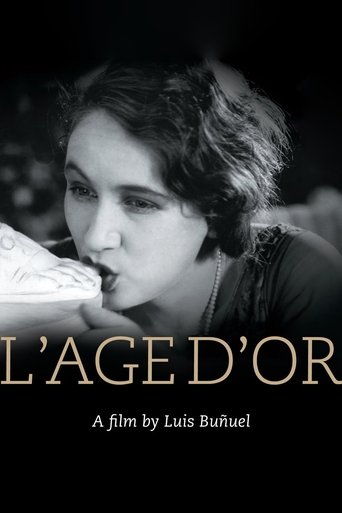
L'Âge d'or (1930)
A surrealist masterpiece.
The film consists of a series of tightly interlinked vignettes, the most sustained of which details the story of a man and a woman who are passionately in love. Their attempts to consummate their passion are constantly thwarted, by their families, by the Church and bourgeois society in general.
- Date of release
- 1930-11-28
- TMDB
- 6.8 / 10 (355)
- Runtime
- 1h 3m
- Genres
- Romance, Comedy, Drama
- Director
- Luis Buñuel
Casting
- Gaston Modot — The Man
- Lya Lys — The Woman
- Caridad de Laberdesque — Marquise' Chambermaid / Girl at Blangis' Castle
- Max Ernst — Bandit Leader in the Hut
- Josep Llorens Artigas — Governor
- Lionel Salem — Duke of Blangis
- Germaine Noizet — Marquise of X
- Duchange — Orchestra Conductor
- Bonaventura Ibáñez — Marquis of X
- Jean Aurenche — Bandit (uncredited)
- Jacques Brunius — Passer-by in the Street (uncredited)
- Luis Buñuel — (uncredited)
Interesting facts
L'Age d'Or, commonly translated as The Golden Age or Age of Gold, is a 1930 French surrealist satirical comedy film directed by Luis Buñuel; the film is about the insanities of modern life, the hypocrisy of the sexual mores of bourgeois society, and the value system of the Catholic Church. The screenplay is by Buñuel and Salvador Dalí. Although L'Age d'Or was one of the first sound films made in France, along with Miss Europe and Under the Roofs of Paris, much of the story is told with title cards like a predominantly silent film. It has been regarded as a founding work of surrealism and one of Bunuel's finest films.
Production
L'Age d'Or began as the second artistic collaboration between Luis Buñuel and Salvador Dalí, who had fallen out by the time of the film's production. A neophyte cinéast, Buñuel overcame his ignorance of cinematic production technique by sequentially filming most of the screenplay; the 63-minute film is composed of almost every meter of film exposed and dramatic sequence photographed.
The production budget was a million francs, and was financed and produced by the Vicomte Charles de Noailles (1891–1981), a nobleman who, beginning in 1928, yearly commissioned a film as a birthday gift to his wife, the Vicomtesse Marie-Laure de Noailles (1902–1970), who was a renowned patroness of the arts and of artists, such as Dalí and Buñuel, Balthus, Jean Cocteau, Man Ray, Francis Poulenc, Jean Hugo, Jean-Michel Frank and others.
L'Age d'Or included actors who were famous artists, such as Max Ernst and Josep Llorens Artigas.
Read on Wikipedia · Text from Wikipedia, CC BY-SA 4.0. Data from Wikidata.
Recommended
- Luna 2018 · ★ 6.4
- Immoral Tales 1974 · ★ 5.9
- (Untitled) 2009 · ★ 6.3
- Restless 2011 · ★ 6.5
- The Spitfire Grill 1996 · ★ 6.5
- Private Fears in Public Places 2006 · ★ 6.4
- My Nights Are More Beautiful Than Your Days 1989 · ★ 6.1
- Kings & Queen 2004 · ★ 7.0
- Shag 1989 · ★ 6.2
- What the Day Owes the Night 2012 · ★ 7.6
- Killer Heat 2024 · ★ 5.8
- Fire with Fire 1986 · ★ 6.2