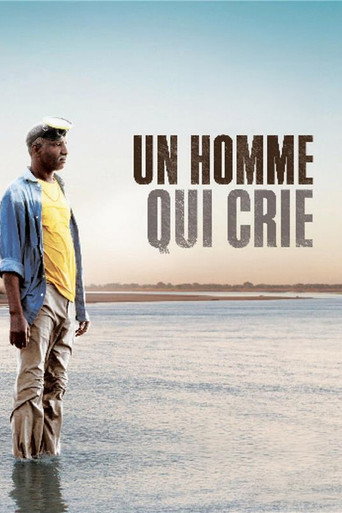
Un Homme qui crie - Ein Mann der schreit (2010)
Un homme qui crie
Der Tschad, heute: Der 60 Jahre alte Adam ist schwer enttäuscht, als er seinen Job als Poolboy in einem Hotel aufgeben muss, während sein Sohn Abdel seinen Posten dort behalten darf. Adam verkauft seinen Filius und Konkurrenten an die Armee, die ihn "kidnappt", um seinen angestammten Job, der alles für ihn bedeutet, wieder zu bekommen und gleichzeitig seinen Obolus an den Militärchef des Viertels zu zahlen. Doch die Schuld lastet schwer auf ihm.
- Erscheinungsdatum
- 2010-09-29
- TMDB
- 6.1 / 10 (34)
- Laufzeit
- 1 Std. 32 Min.
- Genres
- Kriegsfilm, Drama
- Regie
- Mahamat-Saleh Haroun
Besetzung
- Youssouf Djaoro — Adam 'Champion' Ousmane
- Diouc Koma — Abdel Ousmane
- Emile Abossolo M'bo — Le chef de quartier
- Hadje Fatime N'Goua — Mariam
- Marius Yelolo — David
- Djénéba Koné — Djénéba Koné
- Li Heling — Mme Wang
- Rémadji Adèle Ngaradoumbaye — Souad
- John Mbaiedoum — Etienne
- Sylvain Mbaikoubou — Le nouveau cuisinier
- Abdou Boukar — Le maître d'hôtel
- Fatimé Nguenabaye — La voisine
Wissenswertes
A Screaming Man is a 2010 drama film by Mahamat Saleh Haroun, starring Youssouf Djaoro and Diouc Koma. Set in 2006, it revolves around the civil war in Chad, and tells the story of a man who sends his son to war in order to regain his position at an upscale hotel. Themes of fatherhood and the culture of war are explored. Principal photography took place on location in N'Djamena and Abéché. The film won the Jury Prize at the 2010 Cannes Film Festival.
Production
The idea for the film came in 2006 during the production of Daratt. On 13 April rebel forces entered N'Djamena, the Chadian capital, where Haroun was filming, and production was immediately put on hold. The film crew, including the young lead actor who was turning 18 on the very day, were trapped in the desert with no means of communication. This inspired Haroun to try to capture the feeling of imprisonment he experienced during the event.
The French company Pili Films and Chad's Goï Goï Productions produced the film together. Additional co-production support was provided by the Belgian company Entre Chiens et Loups. The two million euro budget included support from the French National Center of Cinematography, and pre-sales investment from Canal +, Canal Horizons, Ciné Cinéma and TV5Monde.
Filming took place during six weeks on location in Chad, starting 30 November 2009. Many of the extras in the film were actual hotel employees, tourists and soldiers who Haroun asked to perform as themselves for the sake of realism. The director recounted the filming in N'Djamena as unproblematic. However, when the crew filmed in Abéché, a stronghold for rebel forces, there was a constant fear among everybody involved in the production.
Auf Wikipedia weiterlesen · Text aus Wikipedia, CC BY-SA 4.0. Daten aus Wikidata.
Empfohlen
- Einer kam durch 1957 · ★ 6.8
- One of Our Aircraft Is Missing 1942 · ★ 6.6
- Der Schatten des Giganten 1966 · ★ 6.3
- Chouans! - Revolution und Leidenschaft 1988 · ★ 5.8
- 15 Minutes of War 2019 · ★ 6.8
- The Way Ahead 1944 · ★ 6.5
- Nur ein einziges Leben 2020 · ★ 6.3
- Hölzerne Kreuze 1932 · ★ 7.1
- J'accuse - Ich klage an 1919 · ★ 7.4
- Der Fuchs 2023 · ★ 7.1
- The War Below 2021 · ★ 6.6
- The Last Rifleman 2023 · ★ 6.6