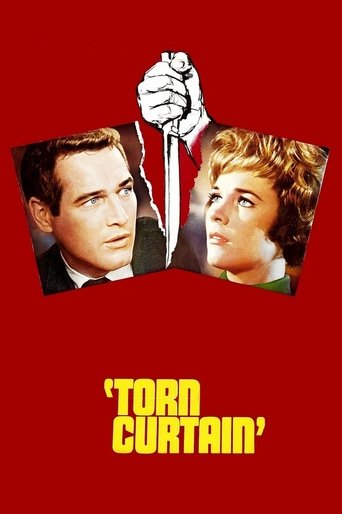
Torn Curtain (1966)
It tears you apart with suspense!
During the Cold War, an American scientist appears to defect to East Germany as part of a cloak and dagger mission to find the formula for a resin solution—but the plan goes awry when his fiancee, unaware of his motivation, follows him across the border.
- Date of release
- 1966-07-14
- TMDB
- 6.6 / 10 (697)
- Runtime
- 2h 7m
- Genres
- Thriller
- Director
- Alfred Hitchcock
Casting
- Paul Newman — Michael Armstrong
- Julie Andrews — Sarah Sherman
- Lila Kedrova — Countess Kuchinska
- Hansjörg Felmy — Heinrich Gerhard
- Tamara Toumanova — Ballerina
- Ludwig Donath — Gustav Lindt
- Wolfgang Kieling — Hermann Gromek
- Günter Strack — Karl Manfred
- David Opatoshu — Mr. Jacobi
- Gisela Fischer — Dr. Koska
- Mort Mills — Farmer
- Carolyn Conwell — Farmer's Wife
Interesting facts
- Box office: $13M
- Budget: $6M
- Earned 2.2× its budget
Torn Curtain is a 1966 American political thriller spy film directed and produced by Alfred Hitchcock, starring Paul Newman and Julie Andrews, and featuring Lila Kedrova, Hansjörg Felmy, Tamara Toumanova, Ludwig Donath, Wolfgang Kieling, and David Opatoshu in supporting roles. Written by Brian Moore, the Cold War narrative concerns an American scientist (Newman) who appears to defect behind the Iron Curtain to East Germany.
Production
By the time Torn Curtain, his fiftieth film, was conceived, Hitchcock was the most famous film director in Hollywood, having already reached the pinnacle of commercial success six years before with Psycho (1960). Audiences eagerly anticipated his next film. To find a gripping plot, Hitchcock turned toward the spy thriller genre, which was greatly in fashion since the early 1960s with the success of the James Bond series starting in 1962 with Dr.
The idea behind Torn Curtain came from the defection of British diplomats Guy Burgess and Donald Maclean to the Soviet Union in 1951. Hitchcock was particularly intrigued by Maclean's life in the Soviet Union and his wife, Melinda Marling, who followed her husband behind the Iron Curtain a year later with their three children.
In autumn 1964, Hitchcock offered to let Vladimir Nabokov, the author of Lolita, who had successfully helped adapt his own novel to a well-regarded film directed by Stanley Kubrick in 1962, write the script. Although intrigued, Nabokov declined the project, feeling that he knew very little about political thrillers.
As the original focus of the plot was on the female lead, the spy's girlfriend, the script was commissioned early in 1965 to Irish-Canadian writer Brian Moore, who was known for successfully tackling female characters. His well-regarded first novel, Judith Hearne, centers on an alcoholic Belfast spinster. In addition to this, Moore had adapted his own novel The Luck of Ginger Coffey into a film the previous year.
To polish the dialogue and improve the script, Hitchcock hired British authors Keith Waterhouse and Willis Hall, known for their screenplays for Whistle Down the Wind (1961), A Kind of Loving (1962), and Billy Liar (1963), the latter based on the novel by Waterhouse. They rewrote some dialogue on a day-to-day basis as the film was shot. However, their contribution was restricted by the director's resistance to change and concern for detail.
Read on Wikipedia · Text from Wikipedia, CC BY-SA 4.0. Data from Wikidata.
Recommended
- The Secrets We Keep 2020 · ★ 6.0
- Hider in the House 1989 · ★ 6.3
- Decision Before Dawn 1951 · ★ 6.8
- Shadow Dancer 2012 · ★ 6.0
- Suburbicon 2017 · ★ 5.9
- The Other 2025 · ★ 6.3
- Icefall 2025 · ★ 6.6
- The Calling 2014 · ★ 5.9
- Buried Alive 1990 · ★ 6.7
- The Unsaid 2001 · ★ 6.6
- Watch on the Rhine 1943 · ★ 6.9
- Blood Punch 2014 · ★ 6.5