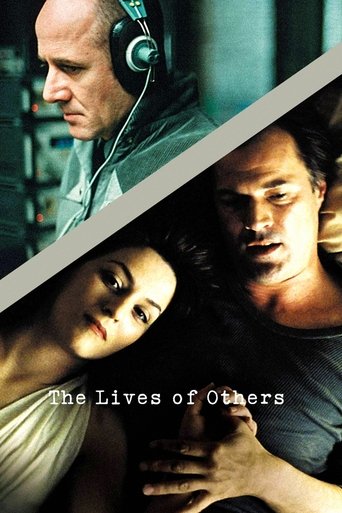
The Lives of Others (2006)
Das Leben der Anderen
Before the Fall of the Berlin Wall, East Germany's Secret Police Listened to Your Secrets.
In 1984 East Berlin, dedicated Stasi officer Gerd Wiesler begins spying on a famous playwright and his actress-lover Christa-Maria. Wiesler becomes unexpectedly sympathetic to the couple, and faces conflicting loyalties when his superior takes a liking to Christa-Maria.
- Date of release
- 2006-03-23
- TMDB
- 8.0 / 10 (4357)
- Runtime
- 2h 17m
- Genres
- Drama, Thriller
- Director
- Florian Henckel von Donnersmarck
Casting
- Martina Gedeck — Christa-Maria Sieland
- Ulrich Mühe — Gerd Wiesler
- Sebastian Koch — Georg Dreyman
- Ulrich Tukur — Anton Grubitz
- Thomas Thieme — Bruno Hempf
- Hans-Uwe Bauer — Paul Hauser
- Volkmar Kleinert — Albert Jerska
- Matthias Brenner — Karl Wallner
- Charly Hübner — Udo
- Herbert Knaup — Gregor Hessenstein
- Bastian Trost — Häftling 227
- Marie Gruber — Frau Meineke
Interesting facts
- Filmed in: Berlin
- Awards: 6 · Nominations: 8. Including: Central Ohio Film Critics Association Award for Best Foreign Language Film; César Award for Best Foreign Film; Academy Award for Best International Feature Film; European Film Award for Best Film
The Lives of Others is a 2006 German drama film written and directed by Florian Henckel von Donnersmarck, marking his feature film directorial debut. The story centres around the covert audio surveillance of East Berlin residents by a senior operative of the Stasi, the secret police of the former East Germany. It stars Ulrich Mühe as Stasi Captain Gerd Wiesler, Ulrich Tukur as his superior Anton Grubitz, Sebastian Koch as the playwright Georg Dreyman, and Martina Gedeck as Dreyman's lover, a prominent actress named Christa-Maria Sieland.
Production
Florian Henckel von Donnersmarck's parents were both from East Germany (originally they were from further east; the von Donnersmarcks belonged to Silesian nobility but the region was transferred to Poland from Germany after World War II). He has said that, on visits there as a child before the Berlin Wall fell, he could sense the fear they had as subjects of the state.
He said the idea for the film came to him when he was trying to come up with a scenario for a film class. He was listening to music and recalled Maxim Gorky's saying that Lenin's favorite piece of music was Beethoven's Appassionata. Gorky recounted a discussion with Lenin:
And screwing up his eyes and chuckling, [Lenin] added without mirth:
But I can't listen to music often, it affects my nerves, it makes me want to say sweet nothings and pat the heads of people who, living in a filthy hell, can create such beauty. But today we mustn't pat anyone on the head or we'll get our hand bitten off; we've got to hit them on the heads, hit them without mercy, though in the ideal we are against doing any violence to people. Hm-hm—it's a hellishly difficult office!
Donnersmarck told a New York Times reporter: "I suddenly had this image in my mind of a person sitting in a depressing room with earphones on his head and listening in to what he supposes is the enemy of the state and the enemy of his ideas, and what he is really hearing is beautiful music that touches him.
Read on Wikipedia · Text from Wikipedia, CC BY-SA 4.0. Data from Wikidata.
Recommended
- M 1931 · ★ 8.1
- Funeral in Berlin 1966 · ★ 6.4
- Two Lives 2012 · ★ 6.6
- Alone in Berlin 2016 · ★ 6.7
- The Tunnel 2001 · ★ 7.2
- Balloon 2018 · ★ 7.5
- The Quiller Memorandum 1966 · ★ 5.9
- The Mask of Dimitrios 1944 · ★ 7.1
- The Bourne Supremacy 2004 · ★ 7.3
- The Last Execution 2021 · ★ 6.2
- Despair 1978 · ★ 6.5
- 23 1998 · ★ 6.8