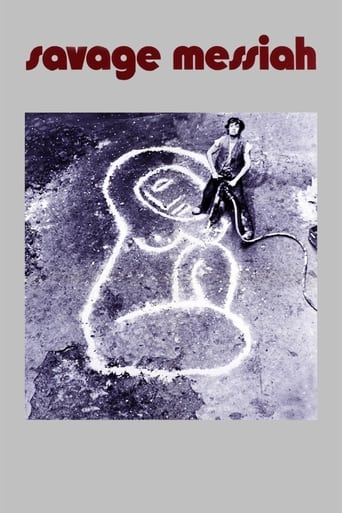
Savage Messiah (1972)
Der Film erzählt eine fiktive Geschichte über die tatsächliche Beziehung zwischen dem französischen Bildhauer und der zwanzig Jahre älteren polnischen Schriftstellerin die wegen der "kreativen Atmosphäre" nach Paris gekommen war...
- Erscheinungsdatum
- 1972-06-27
- TMDB
- 6.4 / 10 (27)
- Laufzeit
- 1 Std. 43 Min.
- Genres
- Drama
- Regie
- Ken Russell
Besetzung
- Dorothy Tutin — Sophie Brzeska
- Scott Antony — Henri Gaudier
- Helen Mirren — Gosh Boyle
- Lindsay Kemp — Angus Corky
- Michael Gough — M. Gaudier
- John Justin — Lionel Shaw
- Aubrey Richards — Mayor
- Peter Vaughan — Museum Attendant
- Ben Aris — Thomas Buff
- Eleanor Fazan — Mdme. Gaudier
- Otto Diamant — Mr. Saltzman
- Imogen Claire — Mavis Coldstream
Wissenswertes
- Basiert auf: Savage Messiah
Savage Messiah is a 1972 British biographical drama film of the life of French sculptor Henri Gaudier-Brzeska, made by Russ-Arts and distributed by MGM. It was directed and produced by Ken Russell, with Harry Benn as associate producer, from a screenplay by Christopher Logue, based on the 1931 book Savage Messiah by H. S. Ede. Much of the content of Ede's book came from letters sent between Henri Gaudier-Brzeska and his lover Sophie Brzeska.
Production
The film was based on the biography by Jim Ede, who had discovered the story while working at the Tate Gallery. Ede had acquired Sophie Brzeska's estate in 1927 from the British Treasury Solicitor after she died intestate. This acquisition included not only her writings, but also the estate of Henri Gaudier, with many of his works and papers.
The book was admired by Ken Russell who said "it will ever be an inspiration to anyone down on their luck with a belief in their own talent, despite the hostility of those who should know better. Here was a tale worth telling on film ... although for years it seemed to be nothing but a pipe dream."
Russell had made a number of films about artists, mostly for television, starting with Two Scottish Painters. His success with feature films such as Women in Love encouraged him to turn the book into a feature.
Russell says because the film was about an artist it was considered an "art film" and was difficult to finance. "I ended up double mortgaging my house and finding most of the money myself", he later wrote. "There was a chance I'd end up on the street but I felt I owed Gaudier something.
Russell said the project "was austere and simple ... my least glamorous film. I was satiated with flamboyance." He said "I wanted to show artists as workers not people who live in ivory towers." Russell later wrote "it was about passion and sweat ... it was about revolution and fuck the art dealers."
Auf Wikipedia weiterlesen · Text aus Wikipedia, CC BY-SA 4.0. Daten aus Wikidata.
Empfohlen
- The Happy Prince 2018 · ★ 6.2
- Colette - Eine Frau schreibt Geschichte 2018 · ★ 6.9
- Trommeln am Mohawk 1939 · ★ 6.5
- Maria 2024 · ★ 6.5
- Hugo Cabret 2011 · ★ 7.2
- Goodbye Christopher Robin 2017 · ★ 7.0
- The Effect of Gamma Rays on Man-in-the-Moon Marigolds 1972 · ★ 7.3
- The Childhood of a Leader 2016 · ★ 6.1
- The Other Woman 2010 · ★ 6.2
- Genauso anders wie ich 2017 · ★ 6.8
- Das wahre Leben der Alice im Wunderland 1985 · ★ 6.6
- Das Glück an meiner Seite 2014 · ★ 7.4