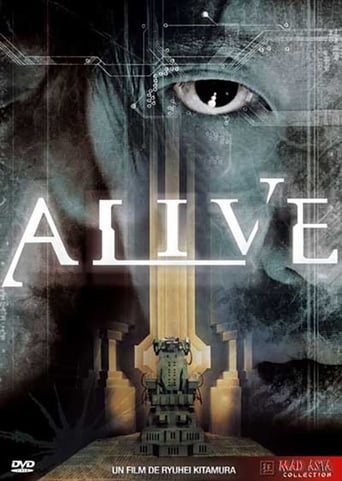
Alive (2003)
ALIVE
Suite à sa survie de son exécution, un condamné à mort accepte de participer à une expérience. Le gouvernement en profite alors pour tester un nouveau virus extraterrestre...
- Date de sortie
- 2003-06-21
- TMDB
- 5.8 / 10 (54)
- Durée
- 1 h 59 min
- Genres
- Action, Science-Fiction, Horreur
- Réalisateur
- Ryuhei Kitamura
Distribution
- 榊英雄 — Tenshu Yashiro
- Ryô — Yurika Saegusa
- Koyuki — Asuka Saegusa
- Shun Sugata — Matsuda
- 小田エリカ — Misako Hara
- 坂口拓 — Zeros
- Jun Kunimura — Kojima
- 水上竜士 — Warden 1
- 木村啓太 — Warden 2
- Minoru Aoki — Warden 3
- Yōji Tanaka — Hair Cut Guard
- 浜近高徳 — Guard 1
Anecdotes
Alive is a 2002 Japanese science fiction film directed and co-written by Ryuhei Kitamura. It is based on the manga of the same name by Tsutomu Takahashi and stars Hideo Sakaki, Ryo, Koyuki, Jun Kunimura, and Tak Sakaguchi. In the film, two death row inmates are confined to an isolation cell with an alien organism that surges the violent nature of its host. Alive was theatrically released in Japan on June 21, 2003.
Production
Technical producer Manabu Shinoda expressed interest in working with director Ryuhei Kitamura after being impressed with Versus. Kitamura proposed an adaptation of the manga Alive to producer Hidemi Satani. However, Satani felt unsure and proposed making a sequel to Versus instead but Kitamura declined, stating: "I didn't want to do something I'd already done".
Kitamura was given a bigger budget than what he was given on Versus and chose to spend the budget on set designs. Kitamura instructed production designer Yuji Hayashida to incorporate post-modern elements. Hayashida turned the cell into a solid metal box due to his fascination with metal structures. Hayashida used an open set for the control room to give a sense of freedom, using only pillars, a steel frame, and wires.
Kitamura didn't want Tenshu to wear prison garb throughout the whole film, feeling it looked "tacky and improbable". Black lab-coats were chosen for the scientists to balance the surreal tone of the isolation cell. Kitamura also wanted the black lab-coats to be more "lustrous". Since the worldview was outlandish, Kitamura wished to only keep the characters grounded in reality.
Kitamura intentionally did not specify the time frame or setting of the film, wishing for the film to be universal. The film originally began with Tenshu being executed by hanging but Kitamura found the idea "too tacky" and decided on an electric chair instead, feeling that an electric chair was "cooler".
The execution scene in the film's opening was filmed near the end of principal photography. A scene was filmed that had Tenshu being led down a giant corridor after the execution scene. The corridor was 150 meters below ground, under construction, and 5 cm, which prevented the crew from bringing enough equipment. As a result, Kitamura was dissatisfied with the way it looked and cut it from the film.
Lire sur Wikipédia · Texte de Wikipédia, CC BY-SA 4.0. Données de Wikidata.
Recommandés
- Hollow Man : L'Homme sans ombre 2000 · ★ 6.0
- Urotsukidôji, la légende du démon 1989 · ★ 6.0
- Ichi the Killer 2001 · ★ 7.0
- Repo men 2010 · ★ 6.3
- Resident Evil : Extinction 2007 · ★ 6.3
- Soulm8te 2026 · ★ 7.5
- The Resurrected 1991 · ★ 6.2
- Death Machine 1995 · ★ 5.8
- Books of Blood 2020 · ★ 6.2
- Dark Angel 1990 · ★ 6.2
- RoboCop 2 1990 · ★ 6.0
- Daylight's End 2016 · ★ 5.9