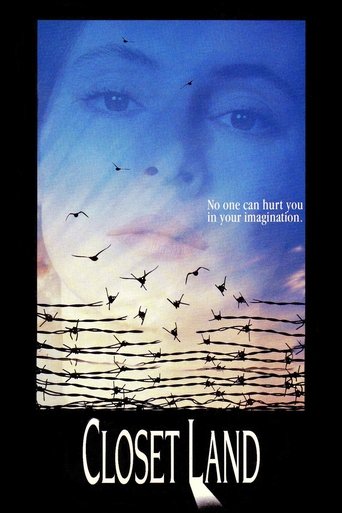
Closet Land (1991)
No one can hurt you in your imagination.
A young writer is interrogated by a sadistic secret policeman. She is accused of embedding political messages in her children's stories. The entire movie takes place in one room, with only the two actors. The movie is set in an unidentified, modern police state.
- Date of release
- 1991-03-06
- TMDB
- 6.7 / 10 (47)
- Runtime
- 1h 34m
- Genres
- Drama, Thriller
- Director
- Radha Bharadwaj
Casting
- Alan Rickman — Interrogator
- Madeleine Stowe — Victim
Interesting facts
Closet Land is a 1991 independent film written and directed by Radha Bharadwaj. The film stars Madeleine Stowe as a young author of children's books and Alan Rickman as a sadistic secret policeman who is interrogating her. The film was released to mixed reviews.
Production
The script was Radha Bharadwaj's winning submission to The Nicholl Fellowships in Screenwriting program in 1989. The Nicholl Fellowships are run by the Academy of Motion Picture Arts and Sciences. Bharadwaj later stated:
That same year, the screenplay was selected to participate in the prestigious Sundance Screenwriting Lab. At Sundance, I met director Alan Rudolph, who encouraged me enormously, pushing me to not compromise or give up in my fight to make my film on my own terms. I put in a cold call to director Oliver Stone's office. To my amazement, he not only read the script himself but also called me in for a meeting.
Bharadwaj said that this film was an outgrowth of her graduate studies at Temple University (PA), that she charmed her Hollywood producers into giving her money to do the film, and that they dropped it upon release.
Stowe and Rickman are the only cast of the film and they are both credited. Bharadwaj later revealed in a September 2005 production note that Rickman was not her original choice for the Interrogator. "If I were to pick my top choices for role of the interrogator in Closet Land," she wrote,
I would still unhesitatingly go with my first choices then: Sir Anthony Hopkins, Sir Ian Holm and Peter O'Toole. All three can capture not only the interrogator's violence and villainy—which is the easy part—but, more critically, his humanity. Evil does not come wearing horns and a tail, nor does it announce itself with flamboyant bombast and grandiose posturing.
Read on Wikipedia · Text from Wikipedia, CC BY-SA 4.0. Data from Wikidata.
Recommended
- A Dry White Season 1989 · ★ 6.6
- The Truth About Emanuel 2013 · ★ 6.0
- Iron Jawed Angels 2004 · ★ 6.8
- The Operative 2019 · ★ 5.8
- Xiu Xiu: The Sent-Down Girl 1998 · ★ 7.2
- Rose Plays Julie 2021 · ★ 5.8
- Land of the Blind 2006 · ★ 5.8
- The Ghoul 2017 · ★ 6.0
- Split 2016 · ★ 5.9
- The Experiment 2010 · ★ 6.4
- My Son, My Son, What Have Ye Done 2010 · ★ 6.1
- The Trials of Cate McCall 2013 · ★ 6.4