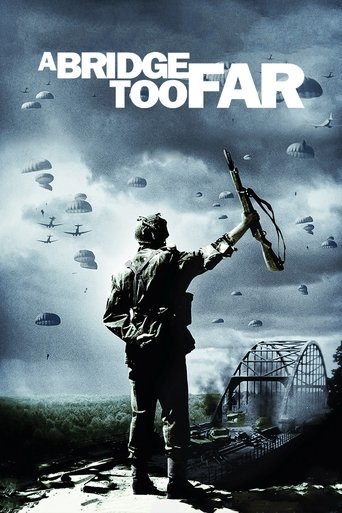
A Bridge Too Far (1977)
Out of the sky comes the screen's most incredible spectacle of men and war!
The story of Operation Market Garden—a failed attempt by the allies in the latter stages of WWII to end the war quickly by securing three bridges in Holland allowing access over the Rhine into Germany. A combination of poor allied intelligence and the presence of two crack German panzer divisions meant that the final part of this operation (the bridge in Arnhem over the Rhine) was doomed to failure.
- Date of release
- 1977-06-15
- TMDB
- 7.2 / 10 (1007)
- Runtime
- 2h 55m
- Genres
- Drama, History, War
- Director
- Richard Attenborough
Casting
- Dirk Bogarde — Lt. Gen. Frederick Browning
- James Caan — SSgt. Eddie Dohun
- Michael Caine — Lt. Col. John O.E. Vandeleur
- Sean Connery — Maj. Gen. Robert E. Urquhart
- Edward Fox — Lt. Gen. Brian G. Horrocks
- Robert Redford — Maj. Julian Cook
- Elliott Gould — Col. Robert Stout
- Anthony Hopkins — Lt. Col. John D. Frost
- Gene Hackman — Maj. Gen. Stanislaw F. Sosabowski
- Hardy Krüger — Generalmajor der Waffen-SS Karl Ludwig
- Laurence Olivier — Dr. Jan Spaander
- Ryan O'Neal — Brig. Gen. James M. Gavin
Interesting facts
- Box office: $50.8M
- Budget: $27M
- Earned 1.9× its budget
- Based on: A Bridge Too Far
A Bridge Too Far is a 1977 epic war film directed by Richard Attenborough. It depicts Operation Market Garden, a failed Allied operation in the Nazi-occupied Netherlands during World War II; the film's screenplay, by William Goldman, is based on a book of the same title by historian Cornelius Ryan. It stars an ensemble cast, featuring Dirk Bogarde, James Caan, Michael Caine, Sean Connery, Edward Fox, Elliott Gould, Gene Hackman, Anthony Hopkins, Hardy Krüger, Laurence Olivier, Ryan O'Neal, Robert Redford, Maximilian Schell and Liv Ullmann.
Production
Air filming was done in the first weeks of September 1976, culminating in a series of air drops of a total of 1,000 men. Supplies were dropped from a number of Dakota aircraft. The Dakotas were gathered by the film company Joseph E. Levine Presents Incorporated. All aircraft were required to be CAA (Civil Aviation Authority) or FAA (Federal Aviation Administration) registered and licensed to carry passengers.
Eleven Dakotas were procured. Two ex-Portuguese Air Force, 6153 and 6171 (N9984Q and N9983Q), and two from Air Djibouti, operating from Djibouti, F-OCKU and F-OCKX (N9985Q and N9986Q) were purchased by Joseph E. Levine. Three Danish Air Force K-685, K-687, and K-688, and four Finnish Air Force C-47s, DO-4, DO-7, DO-10 and DO-12, were loaned for the duration of the parachute filming.
Aircraft 6171 doubled as the camera ship on most formations, with a camouflaged Piper Aztec, G-AWDI. A camera was mounted in the astrodome, one on the port upper mainplane surface, with a third camera on the outside of the forward port cabin window and a fourth under the aircraft centre section. In addition, centre escape hatches were removed to make additional camera ports available, provided that no troops were aboard during filming.
The replica gliders were tail-heavy and required a support post under the rear fuselage, with camera angles carefully chosen to avoid revealing this. Dakota 6153 was fitted with tow gear and Horsa replicas were towed at high speed, though none went airborne. A two-seat Blaník sailplane, provided by a member of the London Gliding Club, Dunstable, was towed aloft for the interior takeoff shots.
Four Harvards portrayed American and German fighters. Their original identities were PH-KLU, PH-BKT, B-64 and B-118, the former two aircraft loaned by the Royal Netherlands Air Force. These were flown by members of the Gilze Rijen Aero Club, which also provided an Auster III, PH-NGK, which depicted an Auster V, RT607, in wartime camouflage. Spitfire Mk. IX, MH434, depicting a photo reconnaissance variant, coded AC-S, was lent by the Hon.
Read on Wikipedia · Text from Wikipedia, CC BY-SA 4.0. Data from Wikidata.
Recommended
- Battle of the Bulge 1965 · ★ 6.9
- The Longest Day 1962 · ★ 7.6
- Greyhound 2020 · ★ 7.4
- The Monuments Men 2014 · ★ 6.1
- Midway 1976 · ★ 6.6
- Overlord 1975 · ★ 6.8
- Taking Sides 2002 · ★ 6.3
- Dunkirk 2017 · ★ 7.5
- Shepherd: The Story of a Jewish Dog 2020 · ★ 6.8
- Midway 2019 · ★ 7.1
- Pressure 2026 · ★ 7.7
- The Scarlet and the Black 1983 · ★ 7.1