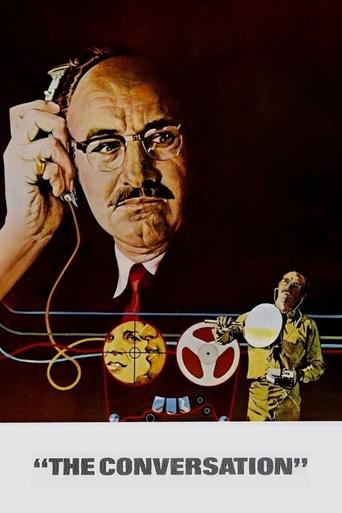
The Conversation (1974)
Harry Caul is an invader of privacy. The best in the business.
A paranoid, secretive surveillance expert has a crisis of conscience when he suspects that the couple he is spying on will be murdered.
- Date of release
- 1974-04-12
- TMDB
- 7.5 / 10 (2173)
- Runtime
- 1h 55m
- Genres
- Crime, Drama, Mystery
- Director
- Francis Ford Coppola
Casting
- Gene Hackman — Harry Caul
- John Cazale — Stan
- Allen Garfield — William P. 'Bernie' Moran
- Frederic Forrest — Mark
- Cindy Williams — Ann
- Michael Higgins — Paul
- Elizabeth MacRae — Meredith
- Teri Garr — Amy Fredericks
- Harrison Ford — Martin Stett
- Mark Wheeler — Receptionist
- Robert Shields — The Mime
- Phoebe Alexander — Lurleen
Interesting facts
- Box office: $4.7M
- Budget: $1.6M
- Earned 2.9× its budget
- Filmed in: San Francisco
- Awards: 8 · Nominations: 12. Including: National Society of Film Critics Award for Best Director; National Board of Review Award for Best Film; National Board of Review Award for Best Actor; National Board of Review Award for Best Director
The Conversation is a 1974 American neo-noir mystery psychological thriller film written, co-produced, and directed by Francis Ford Coppola. It stars Gene Hackman as surveillance expert Harry Caul who faces a moral dilemma when his recordings reveal a potential murder. Supporting cast members include John Cazale, Allen Garfield, Cindy Williams, and Frederic Forrest. Harrison Ford and Teri Garr appear in credited roles, and Robert Duvall in an uncredited role. Mackenzie Phillips, who had just worked for Coppola on American Graffiti along with Williams and Ford, had a supporting role as Harry Caul's niece that was dropped during the film's editing stage.
Production
Principal photography began November 27, 1972, and finished in late February 1973. The original cinematographer of The Conversation was Haskell Wexler. Severe creative and personal differences with Coppola led to Wexler's firing shortly after production began, and Coppola replaced him with Bill Butler, whom he had previously worked with on The Rain People and The Godfather.
Walter Murch served as the supervising editor and sound designer. Murch had more or less a free hand during the editing process because Coppola was working on The Godfather Part II at the time. Coppola noted in the DVD commentary that Hackman had a very difficult time adapting to the Harry Caul character because he was so much unlike himself.
Coppola has cited Michelangelo Antonioni's Blowup (1966) as a key influence on his conceptualization of the film's themes, such as surveillance versus participation, and perception versus reality. "Francis had seen [it] a year or two before, and had the idea to fuse the concept of Blowup with the world of audio surveillance."
Private investigator Hal Lipset is credited as a technical advisor on the film. He chose state-of-the-art surveillance equipment, and had Caul's surveillance follow methods which were mostly realistic. In the film, Lipset and Caul are mentioned as two of the pre-eminent surveillance experts who will be attending a convention.
On the DVD commentary, Coppola says he was shocked to learn that the film used the same surveillance and wire-tapping equipment that members of the Nixon Administration used to spy on political opponents prior to the Watergate scandal. Coppola has said this reason is partially why the film gained the recognition it has received, but it was entirely coincidental.
Read on Wikipedia · Text from Wikipedia, CC BY-SA 4.0. Data from Wikidata.
Recommended
- The Man Who Knew Too Much 1956 · ★ 7.4
- The Net 1995 · ★ 6.1
- Conspiracy Theory 1997 · ★ 6.6
- Mercy 2026 · ★ 7.1
- Woman on the Run 1950 · ★ 6.8
- Insomnia 2002 · ★ 7.0
- The Quiller Memorandum 1966 · ★ 5.9
- The Stranger 2022 · ★ 6.2
- The Mask of Dimitrios 1944 · ★ 7.1
- Missing 2023 · ★ 7.4
- Snowden 2016 · ★ 7.1
- Gourmet Detective: A Healthy Place to Die 2015 · ★ 6.6