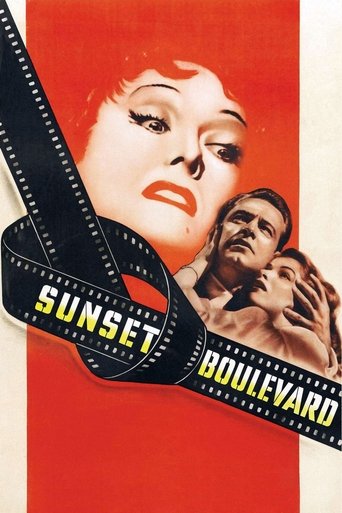
Sunset Boulevard (1950)
A Hollywood Story: Sensational...Daring...Unforgettable...Sunset Blvd
A hack screenwriter writes a screenplay for a former silent film star who has faded into Hollywood obscurity.
- Date of release
- 1950-08-10
- TMDB
- 8.3 / 10 (3097)
- Runtime
- 1h 50m
- Genres
- Drama
- Director
- Billy Wilder
Casting
- William Holden — Joe Gillis
- Gloria Swanson — Norma Desmond
- Erich von Stroheim — Max von Mayerling
- Nancy Olson — Betty Schaefer
- Fred Clark — Sheldrake
- Lloyd Gough — Morino
- Jack Webb — Artie Green
- Franklyn Farnum — Undertaker
- Larry J. Blake — Finance Man #1
- Charles Dayton — Finance Man #2
- Cecil B. DeMille — Cecil B. DeMille
- Hedda Hopper — Hedda Hopper
Interesting facts
- Box office: $5M
- Budget: $1.8M
- Earned 2.9× its budget
- Awards: 5 · Nominations: 11. Including: Academy Award for Best Writing, Original Screenplay; Academy Award for Best Art Direction, Black and White; Academy Award for Best Original Dramatic or Comedy Score; National Board of Review: Top Ten Films
Sunset Boulevard is a 1950 American black comedy film noir directed by Billy Wilder and co-written by Wilder, Charles Brackett, and D. M. Marshman Jr. It is named after a major street that runs through Hollywood and western Los Angeles.
Production
Sunset Boulevard in Los Angeles has been associated with Hollywood film production since 1911, when the town's first film studio, Nestor, opened there. Film workers lived modestly in the growing neighborhood, but during the 1920s, profits and salaries rose to unprecedented levels. With the advent of the star system, luxurious homes noted for their often incongruous grandeur were built in the area.
In 1999 interview with Cameron Crow, Wilder recalled that the project began as a comedy, possibly starring Mae West, before developing into a story about a silent-film star and a screenwriter.
The character of Norma Desmond mirrors aspects of the later lives of several former silent-film stars, such as the reclusive existences of Mary Pickford and Pola Negri and the mental-health struggles of Mae Murray, Valeska Surratt, Audrey Munson, and Clara Bow. Critic Dave Kehr has asserted that Norma Talmadge is "the obvious if unacknowledged source of Norma Desmond, the grotesque, predatory silent movie queen".
Cinematographer John F. Seitz stated that Wilder "had wanted to do Evelyn Waugh's 1948 novel The Loved One, but couldn't obtain the rights." Waugh's story follows Dennis Barlow, a young British poet who is working at a Hollywood pet mortuary. His housemate is Sir Francis Hinsley, an aging screenwriter who has not written anything in years.
Wilder and Brackett began working on a script in 1948, but the result did not completely satisfy them. In August 1948, D. M. Marshman Jr., formerly a writer for Life, was hired to help develop the storyline after Wilder and Brackett were impressed by a critique he provided of their film The Emperor Waltz (1948).
Read on Wikipedia · Text from Wikipedia, CC BY-SA 4.0. Data from Wikidata.
Recommended
- Mank 2020 · ★ 6.7
- Priscilla 2023 · ★ 6.7
- Trumbo 2015 · ★ 7.2
- Two Weeks in Another Town 1962 · ★ 6.0
- Opening Night 1977 · ★ 7.6
- Hitchcock 2012 · ★ 6.6
- Killer's Kiss 1955 · ★ 6.3
- Fat City 1972 · ★ 7.1
- A Double Life 1947 · ★ 6.4
- Synecdoche, New York 2008 · ★ 7.5
- The Lost Weekend 1945 · ★ 7.6
- The Sense of an Ending 2017 · ★ 6.3