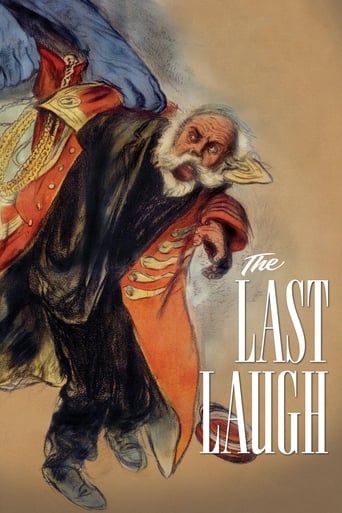
The Last Laugh (1924)
Der letzte Mann
An aging doorman, after being fired from his prestigious job at a luxurious hotel, is forced to face the scorn of his friends, neighbours and society.
- Date of release
- 1924-12-23
- TMDB
- 7.8 / 10 (373)
- Runtime
- 1h 30m
- Genres
- Drama
- Director
- F. W. Murnau
Casting
- Emil Jannings — Hotel Doorman
- Maly Delschaft — His Niece
- Max Hiller — Bridegroom
- Hans Unterkircher — Hotel Manager
- Hermann Vallentin — Potbellied Guest
- Emilie Kurz — Bridegroom's Aunt
- Georg John — Night Watchman
- Emmy Wyda — Thin Neighbor
- Harald Madsen — uncredited
- Carl Schenstrøm — Wedding Musician
- Olaf Storm — Young Guest
- O.E. Hasse — uncredited
Interesting facts
The Last Laugh is a 1924 German silent film directed by German director F. W. Murnau from a screenplay written by Carl Mayer. The film stars Emil Jannings and Maly Delschaft.
Production
Director F. W. Murnau was at the height of his film career in Germany and had high ambitions for his first film with UFA. He stated that "All our efforts must be directed towards abstracting everything that isn't the true domain of the cinema.
The film was shot entirely at the UFA Studios. Murnau and cinematographer Karl Freund used elaborate camera movements for the film, a technique later called "entfesselte Kamera" (unchained camera). In one scene a camera was strapped to Freund's chest as he rode a bicycle into an elevator and onto the street below. In another scene a camera is sent down a wire from a window to the street below, and later reversed in editing.
Murnau noted that the story was absurd on the grounds that "everyone knows that a washroom attendant makes more than a doorman." The signs in the film are written in an imaginary language that Alfred Hitchcock took as Esperanto.
There were three different versions of the film, for German, American and international audiences. While European markets retained the meaning of the original German title (The Last Man) on its initial release, the English-speaking countries opted for the more optimistic Laugh title.
Read on Wikipedia · Text from Wikipedia, CC BY-SA 4.0. Data from Wikidata.
Recommended
- Lola 1981 · ★ 6.9
- The Insider 1999 · ★ 7.5
- Richard Jewell 2019 · ★ 7.4
- King of the Hill 1993 · ★ 6.8
- Come Sunday 2018 · ★ 5.8
- All or Nothing 2002 · ★ 7.1
- Mank 2020 · ★ 6.7
- Small Things Like These 2024 · ★ 6.7
- The House on Carroll Street 1988 · ★ 6.0
- In the Aisles 2018 · ★ 6.9
- Reagan 2024 · ★ 6.3
- Blue Moon 2025 · ★ 6.6